
Woke 2 Aug 13
pirate wires #162 // “woke 1 was crazy,” revolution in the democratic party, and how to talk to normie libs (or partisan hacks) who think “the DSA is just like trump”
177 Likes
30 Comments
Sep 9, 2026

Diversity, equity, and immigration. Is it racist for the American government to prioritize the welfare of Americans over foreigners? Is the nation’s divisive H-1B visa a pathway for the world’s most talented men and women to become citizens, or is the success of the program, and its popularity in Silicon Valley, more a matter of reliably cheap engineering talent? What’s the matter with cheap engineering talent, anyway — don’t we need it? And why does anyone care what a billionaire expat living a luxurious, secluded life in the British countryside thinks about American labor policy?
These were the questions hotly dividing the technology industry when Palmer Luckey, beloved, America-obsessed hard tech founder of both Oculus and Anduril, went to scorched earth war with Paul Graham, former head of Y Combinator and prolific “thoughtful” lib, following what seemed, to the casual eye, Graham’s perfectly reasonable post:
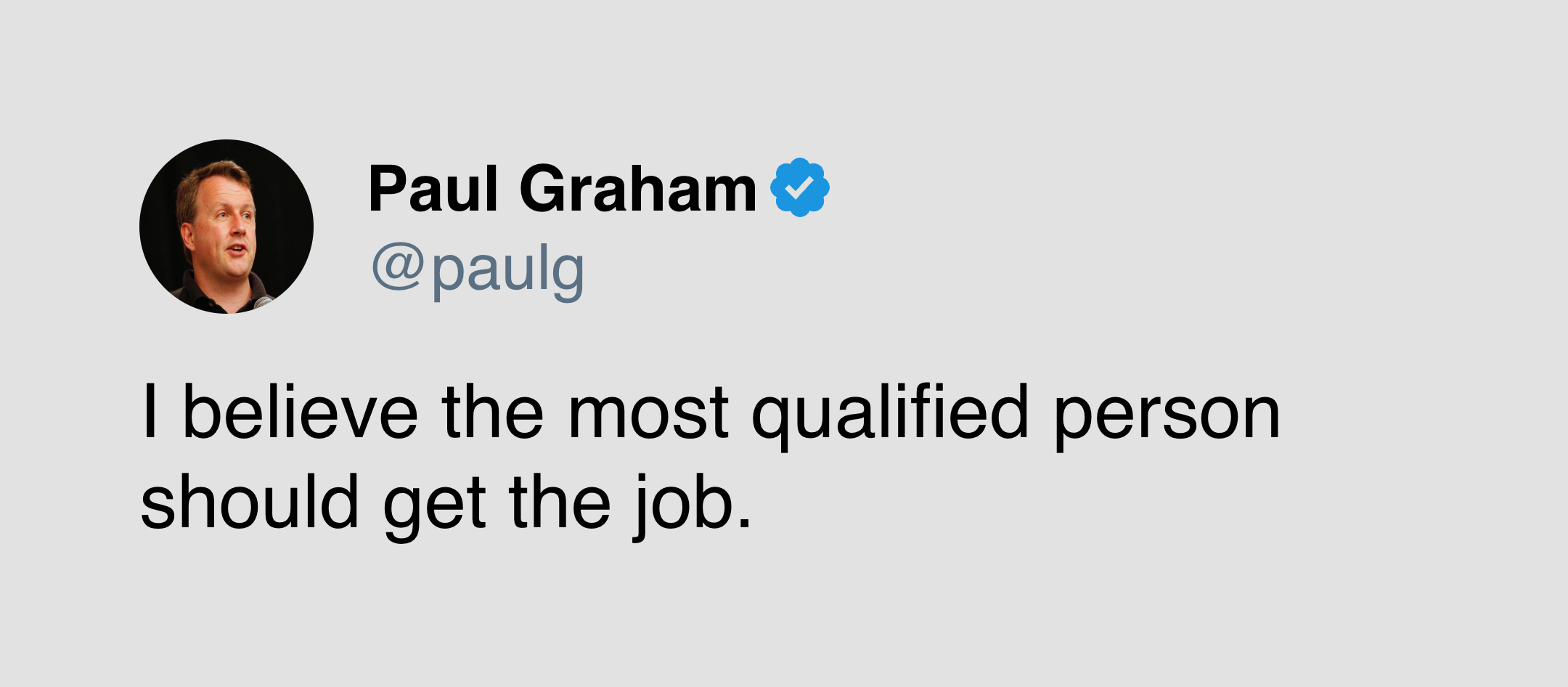
“I believe the most qualified person should get the job.” And who could argue with that?
Palmer replied:
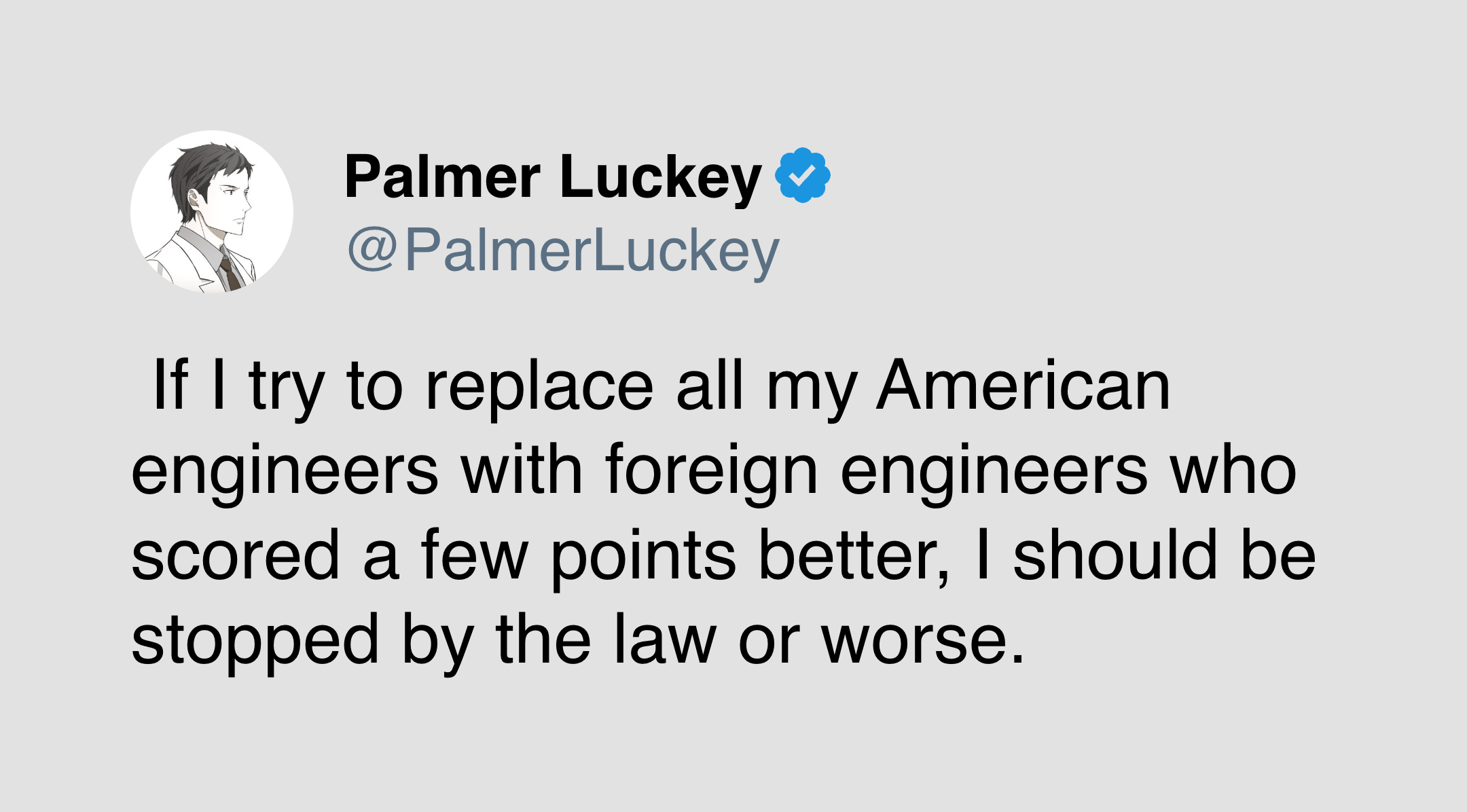
The exchange instantly captured the industry, and not only because of the subject matter. Here was the tech old guard — globalist, performatively thoughtful, happily foreign — instantiated in the body of Graham, challenged by the new class — nationalist, untamed, and as apple pie American as one could get — instantiated in the much younger body of Palmer. To my eye, the conflict seemed at least as much a matter of status as immigration or labor, which on some sub-rational level both men probably felt, and is maybe why things got so personal so fast.
Paul asked if Anduril hired any foreigners, then why, attempting to paint Palmer as either a hypocrite or a moron with a revealed preference for Paul’s political orientation.
Palmer, in a very lengthy reply, tried to pivot back to the purpose of American law, “which should, and does, advantage American citizens.” But one of the words in that multi-paragraph reply was “traitorous,” which Paul then conflated with the word “treasonous.” From here, Paul dragged the conversation away from politics, and into a tedious, protracted argument on semantics, where the entire disagreement became inscrutable. The question was no longer ‘what do Palmer and Paul think about immigration, or labor?,’ but something more like ‘does Palmer think Paul — and his wife? — should be executed, and is he a bad person for saying this on X?’ As Palmer never actually said Paul (or his wife!) deserved capital punishment for Paul’s bad tweets, as Paul alleged, and as that charge is… insane, Palmer naturally interpreted the pivot as a malicious gesture in poor faith, fired back, and the conversation was permanently derailed.
But why was the apparently innocuous subject of hiring “the best candidate” so immediately heated in the first place?
Well, friend, I’m glad you asked.
Just before this second Revolutionary War, the Trump administration proposed a permanent $103,265 fee for H-1B visa petitions, which followed a Massachusetts judge’s determination Trump’s previous temporary fee on the visa was unlawful. (Recent coverage of the fee suggests its combined total might surpass $200,000). Seemingly, the intention of the proposal is to reduce demand for the H-1B, and encourage greater cultivation of American talent. But was it just racist? YC partner Ankit Gupta seemed to think so.
Gupta, in an instantly viral tweet, quote-tweeted Vice President JD Vance, who had written “if an American corporation needs workers, it should hire and train Americans,” with his own position that any such preference among American companies for American workers was akin to DEI, or “Diversity, Equity, and Inclusion.” Oh, right wingers are mad about smart brown people taking the jobs of less smart white people? I thought they believed in meritocracy!
Ankit further characterized “H-1B culture” as willingness to work, in apparent contrast with the average American, who is presumably lazy (an echo of Vivek Ramaswamy’s highly controversial remarks back around Christmas, 2024), and concluded with something truly incredible:
“People don’t like skilled visas like H-1B because they think the counterfactual to a foreign-origin worker in an American job opening is an American worker in it. It’s not. The counterfactual is that job opening getting exported to Shenzhen, Shanghai, Bangalore, Toronto, or London.”
And the “people” to whom Ankit was presumably referring were… not happy.
The notion that our American government’s preference for Americans was in some way the same as institutional discrimination against one race of American over another was not only offensive to the men who, for years, experienced that racism, but conceptually outrageous. Of course a government’s responsibility is to its own people. And this, at the time Paul entered the conversation, was what we were discussing — not the morality of hiring one very skilled candidate over another less skilled candidate, but the displacement of American labor with foreigners, not only at home but also abroad, and not because foreigners are more skilled. But because foreign labor is less expensive.
Now, let’s go ahead and tackle the giant visa in the room.
pirate wires #162 // “woke 1 was crazy,” revolution in the democratic party, and how to talk to normie libs (or partisan hacks) who think “the DSA is just like trump”

the purpose of the wealth tax is not to patch a budget hole, it's to destroy the concept of the wealthy businessman — the last real check on left-wing power in the country

why are lgbt activists in hamtramck, michigan shocked that their all-muslim city government isn't socially progressive?