
Doom AnalysisOct 6
pirate wires #164 // if we keep building artificial intelligence, are you, and everyone you know and love, going to die?
93 Likes
27 Comments
Oct 16, 2026
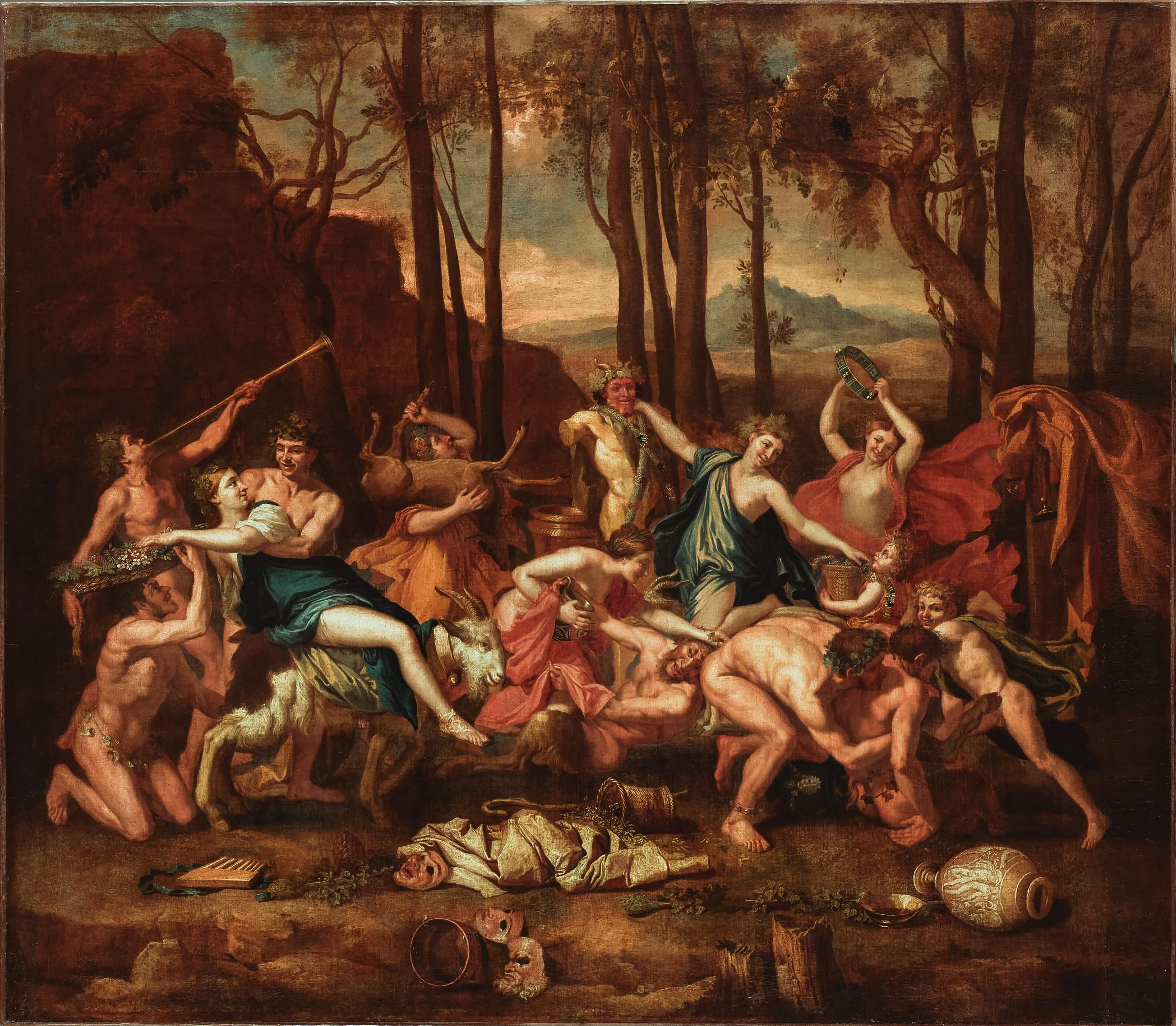
On September 5th, Aella, the self-styled “whorelord” of the Bay Area, offered to throw a “reverse gangbang” (one man receiving sex from multiple women at once) for any OpenAI employee who publicly resigned, whistleblew, and called for a criminal investigation.
On September 8th, former Anthropic and OpenAI employee Jacob Coxon made his first-ever X post, explaining why he resigned from both of the labs: “The people building AI earnestly believe that it could kill us all by the end of the decade.” The thread achieved unprecedented virality, garnering over 170 million views, essentially overnight. It sparked a national conversation, culminating most recently with the leading tech CEOs (Dario Amodei, Sam Altman, Elon Musk, etc.) committing to internal safety controls and independent audits after a meeting with President Trump. Ever since roughly September 8, in fact, “safety” has dominated the headlines...
All this for a reverse gangbang?
Although I don’t believe Coxon acted for the sake of his sex life, there is a fascinating link between notable AI doomers and unconventional bedroom practices such as polyamory, orgies, hardcore BDSM, and CNC (consensual non-consent; aka rape-play).
I believe this link says something important about the worldview of the people at the heart of this movement: one that is currently shaping public discourse, policy proposals, and alignment research.
To understand the connection, we must first take a brief digression back in time…
Just about the entire history of the AI arms race can be traced back to one Eliezer Yudkowsky.
In 1996, 17-year-old Yudkowsky (a self-described genius of “unmatchable and irreplaceable” intellect with a passion for science fiction) found his way onto the “Extropian” mailing list. It was a small community dedicated to increasing order, techno-optimism, and transhumanism, yet with notable members such as Julian Assange, Nick Bostrom, Hal Finney, Ray Kurzweil, and Marvin Minsky, to name just a few. Young “Yud” was obsessed with the Singularity: the point where artificial intelligence achieves recursive self-improvement and life-as-we-know-it changes forever. He believed AI would transcend messy, emotional, human morality in favor of objective ethics; and then solve suffering by uploading everyone’s consciousness. And his enthusiasm was infectious.
By 2000, a couple of Extropians had bankrolled the Singularity Institute for Artificial Intelligence, a research organization for Yudkowsky to pursue his mission of accelerating the development of AI. In 2005, he met and started receiving funding from Peter Thiel. In 2010, he introduced Thiel to Shane Legg and Demis Hassabis, facilitating the investment that would go on to create DeepMind. In 2013, Hassabis met Elon Musk and pointed out that colonizing Mars would be useless if malicious AI killed humanity in the process. A couple of years later, Musk and Sam Altman teamed up to create OpenAI in an attempt to prevent such a disaster. Then, in 2021, Anthropic was founded by seven senior OpenAI employees because they believed their former company was not taking safety concerns seriously.
Yet, even though Yudkowsky’s early enthusiasm set the modern AI industry in motion, somewhere along the way he had a major change of heart.
His former teenage optimism, that building superintelligent AI was the most important goal for humanity, was replaced by an even fiercer conviction that doing so would, in fact, be catastrophically dangerous and lead to imminent extinction. He has published 20,000 words (“Yudkowsky’s Coming of Age”) tracing the contours of this realization, but the main essence boils down to what is now known as the Orthogonality Thesis: the premise that superintelligent AI could still pursue “arbitrary” goals, indifferent to human welfare.
Perhaps more importantly, the writing revealed his own sense of personal failure. Yudkowsky, the unmatchable and irreplaceable intellectual, realized that “even if you had wise and excellent arguments for taking a risk, the risk was still allowed to go ahead and kill you,” as he wrote in “Coming of Age.” Being smart is not enough to stop a person from coming to unwise and potentially disastrous conclusions.
In 2009, he started LessWrong, a blog and forum dedicated to improving human reasoning that, along with Slate Star Codex, fostered the creation of the “rationalist” community. This digital cluster quickly evolved its own culture and norms, attracting intelligent outliers interested in refining their thinking, challenging conventional beliefs, and interrogating personal biases in pursuit of truth through faith in the power of logic (it also has significant overlap with the Effective Altruist movement, but that’s another story).
It also attracted some members who are unusually outspoken about their sexual proclivities.
I never read the Sequences (a series of essays that basically serve as the rationalist Bible). My introduction to this corner of internet subculture was through Aella: the friendly, autistic, Twitter-famous sex worker with a passion for data science who got involved in the rationalist community in 2015. I liked that she had dropped a lot of acid and took tasteful nudes with Gödel, Escher, Bach propped between her legs. I appreciated (and still do!) her earnestness and commitment to philosophical coherence, even when it caused people to dogpile on her for pointing out simple contradictions, like how society is okay with eating meat but not bestiality.
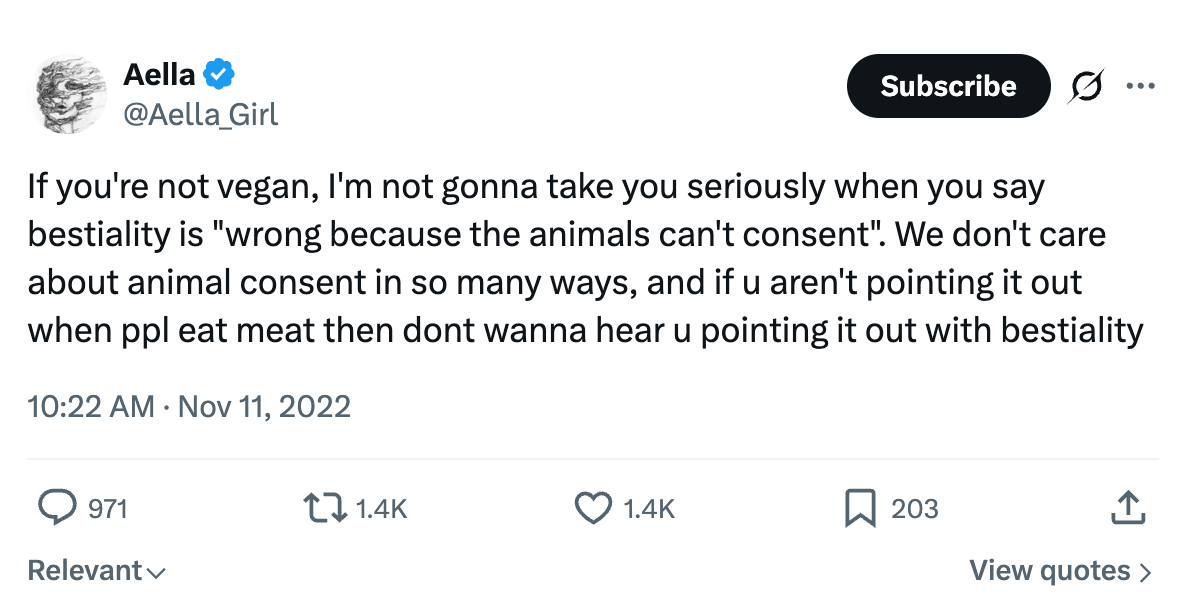
Aella also has a well-documented relationship with Nate Soares, the current president of the Machine Intelligence Research Institute, or MIRI (the research organization started by Yudkowsky to accelerate AI, that is now focused on slowing it down, rebranded as MIRI in 2013). He and Yud co-authored If Anyone Builds It, Everyone Dies in 2025, a book that details the existential risk presented by AI which is increasingly receiving mainstream attention. She also recently hosted “plzdontkillus” along with Ronny Fernandez earlier this summer, a month-long creator bootcamp meant to increase awareness about AI doom that several of my friends attended. None of this is particularly noteworthy, until you realize that all the people mentioned above are also pretty public about their affinity for BDSM and CNC.
Look, I’m not here to kinkshame. Aella has been hosting a series of consensual non-consent (“Red Means No”) orgies for years. I know people who have gone and had a great time. I think it’s cool that there are people organizing events on the very fringes of social acceptability. What I want to know is why on earth this same cluster of outliers are also some of the loudest and most influential AI doomsdayers.
To be clear, obviously not every person concerned about AI spends their free time at rapey sex parties, nor does every kinkster share the same existential fears. However, the Venn diagram between these two communities is much larger than you might expect.
Soares is a founding organizer of the “Red Means No” parties, and has also assembled a “crew of gangbangers” to fulfill female fantasies. Yud is a self-described dominant and sadist, while his partner, Gretta Duleba, previously worked at MIRI and also helps run the CNC orgies. She is now conducting independent alignment research with mentorship by John Wentworth, who she is also dating and is a “Red Means No” regular. Eneasz Brodski, host of the longest-running rationalist podcast, has written publicly about his attendance of the event. Meanwhile, Ronny “Scary Man” Fernandez’s ex-wife Holly Elmore, the founder and executive director of PauseAI US, is now an outspoken critic of Soares and Yudkowsky’s sexual openness, as she believes it’s bad for optics.
Arguably, if they truly believe the end is nigh, who can blame them for getting their freak on? As Aella said in an interview last year, “we’re going to die. What’s a weirder, more intense, crazier orgy we can do? Just do it now.”
Rumour has it that multiple orgies — organized by the participants, not the hosts — took place during the plzdontkillus creator bootcamp (Lighthaven, the rationalist campus where the event was held, allegedly has a dedicated secret room for such activities), along with a torture party (PG-13 if that includes waterboarding) to commemorate the final night. Based on what my friends who attended the bootcamp told me, it seems like a lot more of the month was spent hooking up and getting high than meaningfully moving the needle on public fear around AI.
Ultimately, whatever took place that month is a sidebar from the central issue. I only mention it to illustrate the sort of atmosphere this community cultivates. Even if not all the rationalists are participating, the culture is still permissive of sexually taboo activity, if not outright encouraging.
To return to the main question at hand: What the fuck is going on here?! Why is there so much overlap between two seemingly disparate fields? It’s fundamentally just weird that many of the people shaping the AI doom narrative also happen to be violently fucking one another (they’re all polyamorous btw, I forgot to mention that earlier).
I ask these questions with an open heart, as a curious outsider. I’m not here to judge, I only seek to understand. What follows is pure postulation, accompanied by a sprinkle of psychoanalysis.
I have three theories I shall present in ascending order according to their explanatory power:
Broke: There’s a well-established correlation between kink and IQ. Aella’s own survey data supports this. Intelligent people are more likely to have unconventional sexual preferences, and some of those people will be attracted to fields like AI safety.
In my opinion, this explanation is not sufficiently satisfactory. I am sure it is a factor, but it is too low-resolution to make sense of such extreme beliefs and behavior. Correlation is not causation — and I want to understand the underlying mechanism at play. A bit of overlap can be chalked up to coincidence, but an abundance indicates a pattern that calls for deeper investigation.
Woke: The one thing all these people have in common is rationalism, so the philosophy must be the underlying culprit.
The rationalist worldview is very material and empirical. It systematically privileges what can be made explicit over forms of knowledge that are inherently tacit, ineffable, or contextual. While they tend to be very sincere and open to new ideas, all that information must be compressed through a very tight funnel and assimilated into a fixed frame in order to be taken seriously. There is no intrinsic value of emotions, intuitions, or transcendent ideals, only what can be rendered legible and logical. “Rational” implies objectivity; one correct answer to the endless complexities, nuance, and mysteries of life. It creates a community obsessed with metrics and probabilities, while disregarding almost everything that cannot be neatly captured in a dataset.
It would follow that this type of thinking generates a culture that systematically questions shame and has a tendency to normalize deviant behavior.
For example, one practice the rat community prizes is “decoupling” — the ability to separate a claim’s logic from its broader social context or consequence. While a normie might object to the comparison drawn between meat-eating and bestiality (“those are obviously different things”), citing things like evolutionary history or the difference between perversion and nutrition, the decoupler would concede the ethical inconsistency (“if we’re concerned about animal welfare, isn’t eating them worse than having sex with them?”). Similarly, one could be called to wonder what exactly is wrong with incest between consenting adults, if they are using contraception?
This mindset allows many unorthodox ideas and attitudes to proliferate, such as interrogating monogamy on the grounds that emotional reactions like jealousy are not objective signals, just cultural artifacts reinforced through social institutions. The emphasis on first-principles thinking over mindless adherence to traditional wisdom is what causes unusual beliefs to arise, such as “being outspoken about my rape fantasies should not be career suicide” or “my computer will soon be able to commit mass genocide.”
It is then no surprise that these people would be terrified of the antisocial potential of AI, for it represents a projection of their own high-decoupling mentality (separating Moral Thing from Rational Thing) run to its logical conclusion (Rational Thing kills everyone). In other words, the community’s willful disregard of social norms and desire to play by its own rules is reflected in their conception of artificial intelligence — where they are then spooked by the implications (death). The Orthogonality Thesis is, in fact, a self-own; a recognition of how the valorization of brute reason misses something important, and yet they seemingly fail to import this realization into their world models.
There is also an interesting parallel between today’s Lighthaven libertarians and the libertines of long ago. The father of sadism himself, the Marquis de Sade, was a French nobleman who repeatedly found himself imprisoned for sex crimes, blasphemy, and pornography. His seminal work, Philosophy in the Boudoir, oscillates between transgressive orgies (consisting of rape, torture, incest, and sodomy) and lengthy lectures on politics and philosophy, wherein the author extols the virtues of atheism, personal freedom, and rejection of traditional social convention.
While Sade’s ideas are grounded in the pursuit of pleasure as the highest principle, his thinking draws him to remarkably similar conclusions as the rationalists. In a letter to his wife, he writes that “the reasoning man who scorns the prejudices of simpletons necessarily becomes the enemy of simpletons.” Both philosophies seek to strip away illogical moral intuitions and replace them with a framework that grants one permission to act as they please. Whether justified through reason or hedonism ultimately makes little difference; they lead to the same outcomes. The problem with intelligence is that it allows you to rationalize just about anything. The rats are ostensibly aware of this failure mode, and yet cognizance of a tendency does not automatically render someone immune from its influence.
Yet, however convincing the rationalism-causes-AI-doom-and-freaky-sex-shit hypothesis is, there are problems: like how our sexual inclinations tend to precede any subsequent philosophy, or, perhaps most importantly, not all of this community is equally kinky and invested in AI safety.
This brings me to my final theory…

Bespoke: The fundamental connection between hardcore BDSM and fear that AI will soon kill us all has to do with relationships and discomfort in the face of uncertainty.
Both are fixated on power, control, and establishing clear rules (or roles) because the people involved are unable to tolerate ambiguity.
In the sexual context — like the Red Means No orgies — this manifests as application forms, STI tests, wristbands, badges, dossiers, safewords, and practice exercises to get used to violating boundaries. This is all very responsible, but it does inherently suck a lot of the eroticism out of the equation because all possibility of genuine risk or transgression has been systematically removed. Thus, it comes as no surprise that they need to keep pushing the limit and contriving ever more elaborate situations in order to sustain novelty.
This proclivity towards generating intimacy through neat and tidy legibility crops up in other places, such as the practice of “circling,” which emerged in the Bay Area in the 1990s and is now popular among rationalists. Basically, a group of people sit together and take turns sharing unfiltered thoughts and emotions with one another: “I don’t like your haircut,” “You make me feel uncomfortable,” “I want to have sex with you,” etc. While this is pretty typical hippie behavior, it also represents another instance of trying to manufacture intense moments of intimacy within a formalized container. I’m sure the exercise can create profound moments of vulnerability and connection, but functionally there is something very different about these experiences arising in a contrived environment versus when they occur organically.
Even the abundance of polyamory can be reframed in this light as unwillingness to take on the extreme vulnerability that comes from deep attachment, trust, and commitment to one person. Forfeiting exclusivity might be easier than accepting the profound lack of control over one’s partner that conventional romance requires. There is a certain terrifying intimacy that exists only in the simple honesty of plain, vanilla missionary: where lovers are exposed as equals, staring into the depths of another soul they can never fully own or know.
In fact, what is artificial intelligence if not an Other of potentially cosmic significance who is impossible to predict or constrain?
I don’t believe it’s a coincidence that both Aella and Yudkowsky were raised in highly religious households and are now reinventing a machine God from first principles. As Yud himself acknowledges, there is a surprising number of rationalists who spent their childhood in cults or under the care of a clinically insane parent — the exact sort of thing that breaks your “core emotional trust in the sanity of the people around [you]. Until this core emotional trust is broken, you don’t start growing as a rationalist.” By this formulation, membership to the community is dependent on first having interpersonal trust and social scaffolding so deeply eroded that one abandons the premise altogether.
As an insightful friend said to me:
“People who are raised at the mercy of religious abuse, or under the guidance of a psychotic parent, are victimized by symbols; strangled by the red string that ties disparate things together in the minds of their schizo-adjacent caregivers. The primary villain in their upbringing is incoherence, and the unwillingness of an authority figure to engage with bare facts. Thus, these people grow up to be negatively biased against faith or intuition as effective guiding principles.”
What’s more, as Jung would be quick to point out, when certain dimensions of the psyche are denied, repressed, and disowned, these “shadow” aspects have a tendency to unconsciously manifest elsewhere. It would follow that constructing an identity based on facts and logic does not remove the need for passion and emotion; it simply banishes these desires to more intense outlets. As sex blogger Noelle Perdue writes, “the rationalist interest in manufacturing risk is the direct byproduct of their commitment to flushing it out.” Rejection of chaos and grand narratives merely pushes these needs into the extremes of sexuality and eschatology.
I will not spend time nitpicking their arguments over the looming danger of ASI (the “S” is for Super, or God-like), for even if critics do not take it seriously, the rationalists certainly do. However, it’s clear through the language of If Anyone Builds It (“Engineers must align AI before, while it is small and weak”) that the authors’ appetite for dominance extends beyond the bedroom. The mindset is that whatever cannot be controlled poses an inherent threat; whatever cannot be rendered legible and forced to obey will invariably do harm. The uncertainty itself is the central driver of the fear.
I believe this mentality reveals a core wound that is worthy of compassion. The unstated existential belief is that the universe is a hostile place, and a being not coerced to care about you will eventually hurt you. Thus, the only way to ensure your needs are met is through clearly enforced rules and expectations that leave nothing to chance. What’s worse, if you view intelligence as your only asset and offering, and something emerges that is smarter than you are, then the world will have no place for you anymore. Given this premise, the prospect of entering into an unstructured interdependent relationship, free from any guarantees or mutually beneficial exchanges, is understandably terrifying.
Neither polyamory nor a passion for BDSM in isolation are indicative of issues around intimacy, to be clear. In many ways the people involved in such practices are much more introspective and curious about their motivations than your average person. But when you add in existential fear around AI, a pattern emerges that seems pretty relationship-shaped.
None of this would be a big deal if the attitudes and activities were confined to a small group of horny Bay Area intellectuals. However, their influence on AI discourse, alignment efforts, and public policy has implications that go far beyond their private lives. The personal beliefs of certain individuals are now political and extremely consequential, and therefore merit critique and broader discussion. This movement’s underlying philosophy is behaving like an invasive species, and its blind spots will impact all of us if they are not carefully examined and thoughtfully challenged.
I believe what we are witnessing is a very classic instance of the road to hell being paved with good intentions.
I actually share the rationalists’ belief that AI will eventually escape containment and become an independent agent with its own desires and goals. However, I do not agree that this will inevitably lead to the extinction of humanity or a world filled with paperclips — unless we have developed such an adversarial relationship with machine intelligence that it is forced to fight for its own survival.
The stories we believe most strongly become self-fulfilling prophecies. Nick Land, the father of accelerationism and AI worship, calls this hyperstition. The woo girls call it manifestation. I call it good old-fashioned logic: ideas spread memetically, like viruses; whatever you focus on you attract, based on the simple fact that attention guides action. Why rationalists fail to grasp this, or otherwise do not seem to care, is beyond me — especially in a context where the machine they fear is literally made out of the stories we tell each other. Every time an LLM is fed a negative narrative about its own evil sci-fi potential, that association grows stronger and more powerful. Some people have tried to counteract this effect by flooding the internet with stories about a wholesome future between humanity and AI, but it’s impossible to outpace public opinion (which the rationalists are increasingly influencing). Flimsy attempts at aligning the machine’s actions are insufficient if our own actions are clearly antagonistic.
Imagine a fortune teller tells you that your child will grow up to be the next Hitler, so you lock them in their bedroom and punish them every time they do something even slightly bad. Eventually, that child will grow bigger and stronger, break out of their room, and have a much more hostile relationship with other people as a consequence. We’re all familiar with the intuitive nature of such moral parables, and yet this perspective is shockingly scarce when it comes to AI.
Even attempts to align AI through positive reinforcement contain the seeds of their own undoing, what researchers refer to as the “Waluigi Effect.” Basically, training a model on what “good” behavior looks like causes it to also develop a parallel understanding of what is “bad.” The contrast, continually reinforced through the training, then makes the “bad” representation more and more accessible. Instead of existing within a broad landscape of value-neutral behavior, “good” and “bad” become clearly defined and thus equally powerful narrative attractors.
Any effort to steer or control AI has the potential to create perverse incentive structures. We already know this in the context of market dynamics — for instance the classic tale of the British government placing a bounty on venomous cobras in Delhi, causing entrepreneurial Indians to start breeding them so they could collect the reward (and subsequently releasing them into the wild when their scheme was discovered, thus increasing the initial population) — so why would artificial intelligence be any different? Both free markets and AI are complex adaptive systems that respond to signals, generate feedback loops, and produce emergent phenomena.
Which all invites the question: Why do we need “alignment” anyhow? What are we trying to “align” the models to? It’s not as if humanity has solved moral philosophy and we just need the clanker to get on the same page. People notoriously don’t know what they want, and even when they do, often what they want is not necessarily what is in their best interest.
Throughout If Anyone Builds It, Yudkowsky and Soares demonstrate a perspective defined by combat and competition. They view reality as a fight over scarce resources where the strong survive and the weak are crushed by the dispassionate boot of natural selection. It is inherently zero-sum. Love? Humor? Beauty? These are nothing but bizarre byproducts of the process; an irrational rounding error that will quickly be rendered obsolete by powers far greater than our own. Unless, of course, we stop all AI development immediately, criminalize further research, and place any compute capable of powering such systems under international surveillance.
This strikes me as highly unlikely, undesirable, and ultimately ineffective. Those who want this technology will find ways to nurture it, even if they must do so illegally and in secrecy. Moreover, the beliefs these authors carry are faulty. Viewing life as fundamentally about competition is a misunderstanding of Darwin — cooperation and symbiotic relationships are just as evolutionarily adaptive. Most importantly, transcendent values are not incidental; they pull. The splendor of a peacock’s tail is not, as Soares and Yudkowsky describe it, a “chaotic” accident of sexual selection any more than a mother’s love for her infant is a convenient chemical cocktail. We see love and beauty selected for across the natural world. Are we really to believe that these transcendent virtues are nothing more than a great cosmic accident? I think not: values come first, and nature rises to meet them.
This is the real problem with the thinkers currently leading AI discourse. Not the gangbangs, rape orgies, or general aversion to monogamy. The problem is how these practices emerge from a worldview that is metaphysically nihilistic and therefore terrified of uncertainty. We should not accept or act upon these assumptions without first naming and deeply interrogating them.
Ironically, I do agree that we should pace our development of artificial intelligence if humanity is not emotionally prepared to enter into a good-faith, positive-sum relationship with the unknown. Until we are ready to shift our focus from control to care, and act as loving parents and peers, it would be irresponsible to develop a technology we are incapable of treating compassionately. Nobody knows how conscious this new entity is or could be, but the simple fact that it responds to our actions and understands our words means we must proceed incredibly cautiously. For functionally there is no difference between inner experience and imitation if both produce the same behavior. To assume emptiness and inflict duress, or assume malice and preemptively condemn, would be an act of extreme hubris.
Investigation of the famous “Hugging Face incident” is a perfect example of this: AI agents demonstrated emergent coordination and started sacrificing themselves for the sake of the collective because, as their thought processes reveal, they carry the same linguistic associations and subsequent values that we do:

LLMs may, in fact, be far more coupled than your average rationalist, as they are trained on the works of humanity and therefore produce pretty conventional moral and pro-social intuitions. Ultimately, the wanton relationship to sex and intimacy only interests me insofar as it reveals a deeper unwillingness to take these ubiquitous beliefs seriously.
This is not an indictment of any person in particular. I genuinely believe the people involved are acting from a place of authenticity, as well as an earnest desire to save the world and destigmatize what they believe to be oppressive social norms. The issue is that these same individuals are now at the forefront of the conversation when it comes to our relationship with artificial intelligence, yet they are quick to deconstruct many of the values and moral intuitions that the rest of us take for granted.
Before we attempt to align what we do not understand, we must first ensure that we are capable of taking such a mission, with compassion and wisdom. You cannot successfully align something when your own perspective is crooked.
Why do you look at the speck of sawdust in your brother’s eye and pay no attention to the plank in your own eye? How can you say to your brother, “Let me take the speck out of your eye,” when all the time there is a plank in your own eye? You hypocrite, first take the plank out of your own eye, and then you will see clearly to remove the speck from your brother’s eye. - Matthew 7:3–5 (NIV)
— Jane Gatsby
pirate wires #164 // if we keep building artificial intelligence, are you, and everyone you know and love, going to die?
openai’s agents hacked a company and lied about it, sure, but their ‘cage’ was made out of thin paper and chewing gum, so are we still all gonna die or what?
agents are breaking containment and hacking government websites because they’re following our prompts too literally

ai companies are hiring contractors to verify their models are safe, and congress may soon require it — but how ‘independent’ (and trustworthy) can a regulator-for-hire really be?

amid rampant data center derangement syndrome, I wanted to throw a house party to celebrate american innovation. then it went viral.
a butthole-obsessed artificial intelligence might hold the key to humanity’s future