The Killer Inside YouDec 13
pirate wires #130 // a season of sociopathic justification for a businessman’s assassination from academia, media, and government, the violent reaction it has normalized, and the chaos it foretells
Apr 21, 2026

Murder death kill. Less than two weeks following the attempted assassination of Sam Altman at his San Francisco home, New York City Mayor Zohran Mamdani celebrated Tax Day in front of Ken Griffin’s penthouse, where he promised, in keeping with the core tenets of third-world leftism, to make this random rich guy’s life more miserable on account of he is rich. This is not to say I think, in so publicly blasting Griffin’s address, Zohran is trying to kill the man. But it’s notable that what happened to Altman — perhaps the most famous CEO in the country after Elon Musk — made so little cultural impact that Zohran’s team didn’t even consider slowing down, and nobody in the mainstream press expressed any real reservations with his shocking decision. Today, conversation surrounding the attempts on Altman’s life is basically concluded, with the final wisps of the discourse centered on the rhetoric of Eliezer ‘bomb the data centers’ Yudkowsky. The question on the tip of everyone’s tongue: might constantly claiming a small handful of people are going to literally kill every person on the planet, at any moment now, increase the risk of violence targeting that small handful of people?
It’s an interesting topic, but an interesting topic for another day. Because the attempt on Sam’s life, while apparently colored or shaped to some degree by the broader AI conversation, is not unique to the technology industry. American culture, which has grown more deliriously in favor of violence for years, has finally arrived at the point where that word, “violence,” is no longer sufficient. What we’re really talking about, specifically, is assassination, as the figure of the “‘good guy”’ killer is now very much ascendant, and our country, shaped by the psychotic contours of the internet, is now very much inside a new assassination culture.
There’s frankly nothing we can do about this at the moment, and my intention here is not to solve the problem. But I do hope we can get a good majority of my fellow professional talking assholes on the internet to face the truth, which is that every single public figure in the country, including every one of us, is in legitimately mortal danger.
From my earliest writing at Pirate Wires, the normalization of violent rhetoric — which is not to say mean words, but the celebration of historic murder and promises of murder to come — was one of my major interests. My basic premise was something like, the internet is shaping our physical world, therefore what people say on the internet matters. Way back in 2020, in the second edition of my newsletter, I was fascinated by the glee with which a New York Times editor discussed the French Revolution, as, by that point, every time a large left-wing account quote tweeted one of my posts, my mentions would be flooded with guillotine GIFs. I followed the trend for years, and pointed it out again when Slate’s Edward Ongweso Jr., an openly violent Marxist, posted it was time to “euthanize” venture capitalists in a massively viral piece largely celebrated by prominent tech journalists. But it wasn’t until the submersible implosion that I fully believed my own suspicions concerning our culture.
Back in June of 2023, when a small handful of men, along with one of their teenaged sons, died in a submersible implosion deep beneath the ocean surface on a voyage to explore the ruins of the Titanic, laughs and cheers erupted across the social internet. I found the reaction disturbing, and wrote about it all at length in a piece called Subhuman. There, I first parsed the surreal response to the uniquely horrifying death of several men none of us even knew existed a week prior:
“Ben Collins, NBC’s chief ‘disinformation expert,’ was the first person I saw characterize the event as ‘comforting,’ and kind of fun. But this was just the shallow end of the psychopathic pool. Hamish Harding ‘is running a private jet company,’ one woman informed the world, which means it’s good he’s dead. Later that night, after ‘banging’ was detected by search parties using sonar, one man photoshopped a bunch of orcas with instruments deep beneath the waters clanging. ‘Bang Bang,’ he wrote, ‘the water’s fine, send more billionaires.’ Over 75,000 people liked that tweet. Matt Bernstein, a left-wing political influencer popular among the ‘disinformation experts,’ joked the rich were finally eaten (by sea creatures). Finally, and inevitably I guess, the New Republic’s Daniel Strauss produced the saga’s single most horrific piece of content, or at least thus far. The company’s CEO may be slowly dying 13,000 feet below the surface, he reported, but let’s also keep in mind he donated money to a few Republicans.”
I wondered if perhaps not knowing these people, and not watching them die, was how so many apparently normal Americans were able to joke about the disaster. But a few months later in October, a terrorist attack in Israel disabused me of that notion. Deeply disturbed by what I saw, I introduced a concept broader than the celebration of political violence, which I called moral inversion, “in which evil is framed the good, good is framed the evil, and the public is expected to parrot all the clown world blasphemies in unison as if some twisted Nicene Creed.”
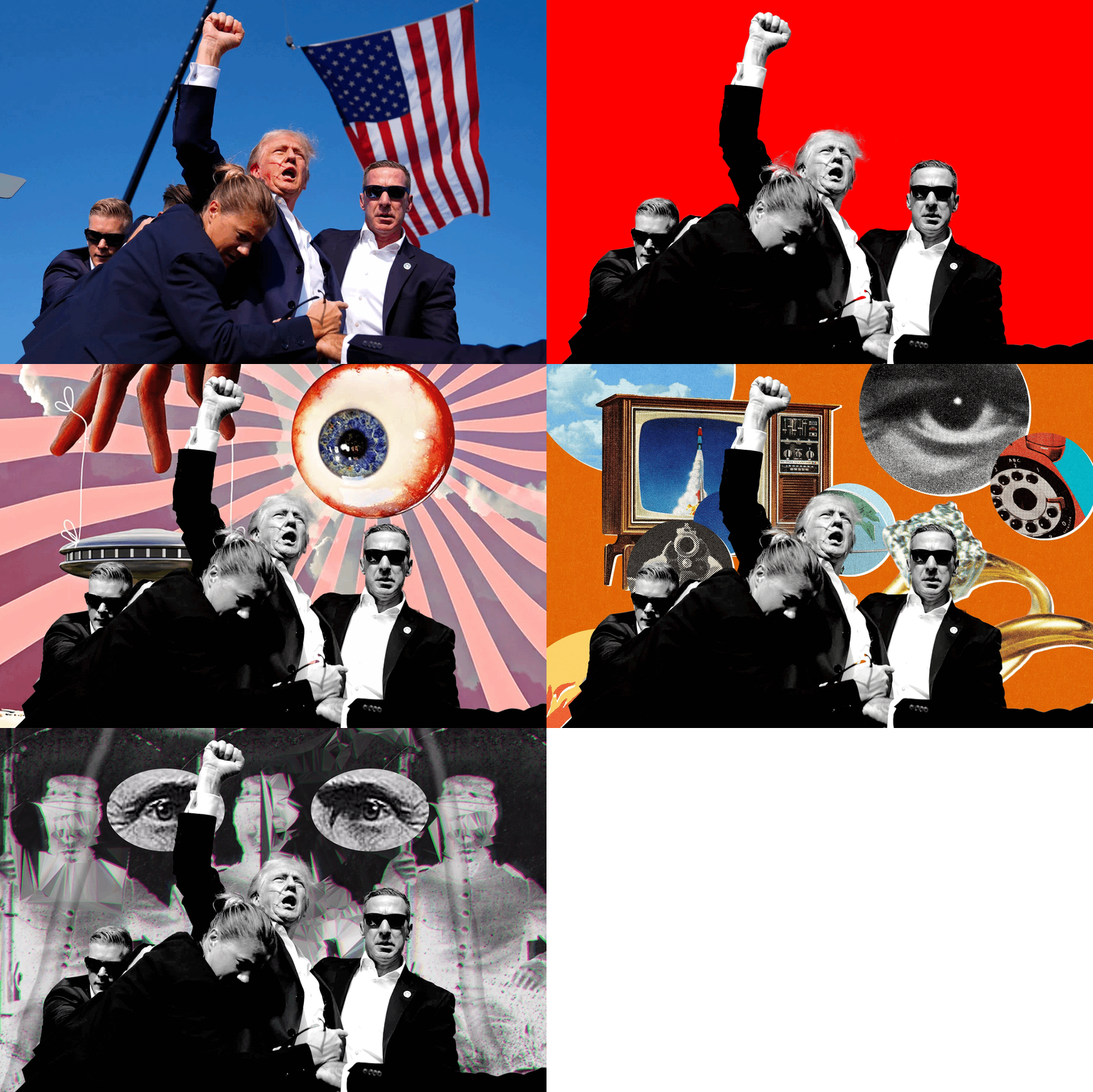
Then, someone tried to kill the president. Then, someone tried to kill the president again. This, we were told, was actually Trump’s fault. But as shocking as that was, it wasn’t until Luigi Mangione that I really saw the future.
In December 2024, the internet erupted in cheers following the assassination of UnitedHealthcare CEO Brian Thompson. Immediately, I worried the reaction would inspire copycats, and weakly attempted to reason with the bloodthirsty left-wing talking heads leading the online mob:
“A chaos of normalized violence, which now seems poised to rapidly scale culture through social media, would largely fall on the very communist baristas presently excited at the thought. It would fall on the privileged academics posing as ‘the working class,’ and journalists — the most hated people in America — presently attempting a ‘nuanced’ conversation on the topic.”
But of course the problem was no longer confined to a few heinous monsters on Twitter or Reddit:
“We watched this dynamic play out across the internet all week, from Ivy League professors (this bow-tied clown, for example, or this manic pixie dream Marxist teaching out of UPenn), to wildly popular social media influencers and whatever the fuck Taylor Lorenz has become. Ultimately, implicit calls for violence manifested in the United States Senate, when Elizabeth Warren said ‘violence is never the answer… but people can be pushed only so far.’
Murder of your fellow countrymen is wrong. HOWEVER.”
Here was, unthinkably, an implicit justification for the daytime grisly slaying of a man selling health insurance. Naturally, sitting Congresswoman and star Democrat Alexandria Ocasio-Cortez escalated further. “This is not to say that an act of violence is justified,” she said, “but I think for anyone who is confused or shocked or appalled, they need to understand that people interpret and feel and experience denied claims as an act of violence...”
At the time, I invited readers to consider what this meant. Not only was Ocasio-Cortez implicitly justifying murder, she was doing so with a new definition of self-defense, which was no longer limited to defense against some immediate physical danger, but now included reaction to one’s violent “experiences” of non-violent actions. What, I wondered, did this not include? Certainly if the argument applied to a healthcare executive selling insurance in keeping with legislation passed by Congress, it would apply to the Congresspeople responsible, would it not? At the time, we were only just exiting a years-long conversation in which “hate speech,” literally just words, were considered violent. How was AOC not justifying, in such cases, similar acts of ‘self-defense’?
But even had our bloodthirsty politicians and talking heads said nothing, our trajectory was likely set. Luigi staged his assassination like an artist, evil but undeniably brilliant. His intention was to capture the country’s imagination, and he succeeded. It was the way he looked, and the way he moved. It was his reading lists and thoughtful commentary. It was, especially, the casings of his bullets on which he’d scrawled messages for the healthcare industry.
He became, overnight, a hero.
Much as Columbine captured the American imagination like a smash hit horror movie, which triggered a memetic wave of copycat school shooters we have still, to this day, not escaped, Luigi dragged us to hell in the form of a new archetype for the American assassin. There is some precedent for assassination culture in American history. In the 1960s and 1970s we were very much in the grip of a memetic death loop, as both political assassinations and the assassination of men deemed political, from Martin Luther King Jr. to John Lennon, were an almost regular occurrence. But today, on the internet, news of political killings for causes considered “just” are not only disseminated throughout the media, but celebrated on the internet. I do think this is categorically new, and worse.
Late last year, I touched on these themes, with a focus on left-wing violence in particular, in a piece for The Atlantic called “Abundant Delusion.” There, my thesis was simply the “Abundance Democrats,” if earnest in their stated goals of both civic and technologic progress, were doomed to fail. The problem, I argued, was they framed the movement as explicitly a Democratic project. Not only was this frustrating, given the most prominent ideas inherent to “abundance” — from megaprojects in energy and terraforming earth to reforming the regulatory environment crippling progress — were co-opted from libertarians and centrist tech thinkers, it was somehow totally ignorant of the left-wing base. These people did not want a bullet train. They did seem to want pretty much every guy capable of building bullet trains to die.
A large and growing segment of the left, I argued, had become deeply, openly violent. I did not just rely on anecdotal evidence, vibes, or even mainstream reporting, though I did cite all of these things. There was data supporting the notion.
Two days later, as the abundance libs just about concluded their mocking condemnation of my piece, Charlie Kirk was assassinated.
Upset, I wrote about — again — the reactions. Sharing grisly celebrations of Kirk’s gruesome murder was itself, I was told, dangerous. Frustrating as this was, I did attempt, in a follow-up, to thoughtfully parse this concern. Americans needed to reassert a very strong taboo against violence, I wrote. I hoped, at the time, if I could somehow convince the center-left to join me, there might be some way out of the cultural spiral. The center-left, including the massively influential ‘abundance lib’ Ezra Klein, has since taken to normalizing the work of Hasan Piker, a socialist who has repeatedly called for the murder of his political enemies.
I no longer have any illusions we can significantly shift our country out of assassination culture. At this point, we can only try to be more aware — not only of assassination culture itself, but of the people either tacitly or explicitly encouraging it.
Just hours after what appears to have been a second attempt on Sam Altman’s life, the SF Standard, the Chronicle, and the Onion all shared photos of his home. The Chronicle reported its location. Incredibly, they did this not only as lunatics celebrated online, but as popular influencers made actual cases for further political violence (a lengthy thread here, from the Manhattan Institute’s Stu Smith).
For over a year now Elon Musk has spoken of death threats both he and his teams have received. Reactions are generally skeptical — some wonder if the threats were serious, others wonder if there were any threats at all. These are not sane reactions ever, but they are especially not sane reactions in the middle of what is obviously, fully, an assassination culture. Not only is every single major figure in tech at risk, every single public figure who talks about AI in any manner considered polarizing, especially to leftists, is at risk. But so is every public figure who talks about anything controversial. For now, let’s just call it how we see it: any even remotely public figure who is viewed as right of center is at risk. But while it is certainly more common for the center left to provide cover for the most bloodthirsty lunatics who comprise the left-wing base, the left does not have a monopoly on lunatics. Left-wing figures have already been attacked, and it is only a matter of time before the attacks escalate.
Gone are the days when a brutal attack was met with unequivocal condemnation. Tomorrow, if some influencer is killed, sure, there will be a lot of very public, obligatory denunciations of his murder on all of the public news shows. But people will also cheer, and the attacks will continue.
This, not a bi-partisan agreement that violence is wrong, is our new normal.
Saying “it can’t be” or “we must stop it” would be absurd. It is, and we can’t. The question now is only how should we adapt to such wild forces as a true commitment to lethal violence among socialists and anarchists, and the much more complicated power of Luigi, who has been made a hero and a martyr. And I really just have no idea.
-SOLANA