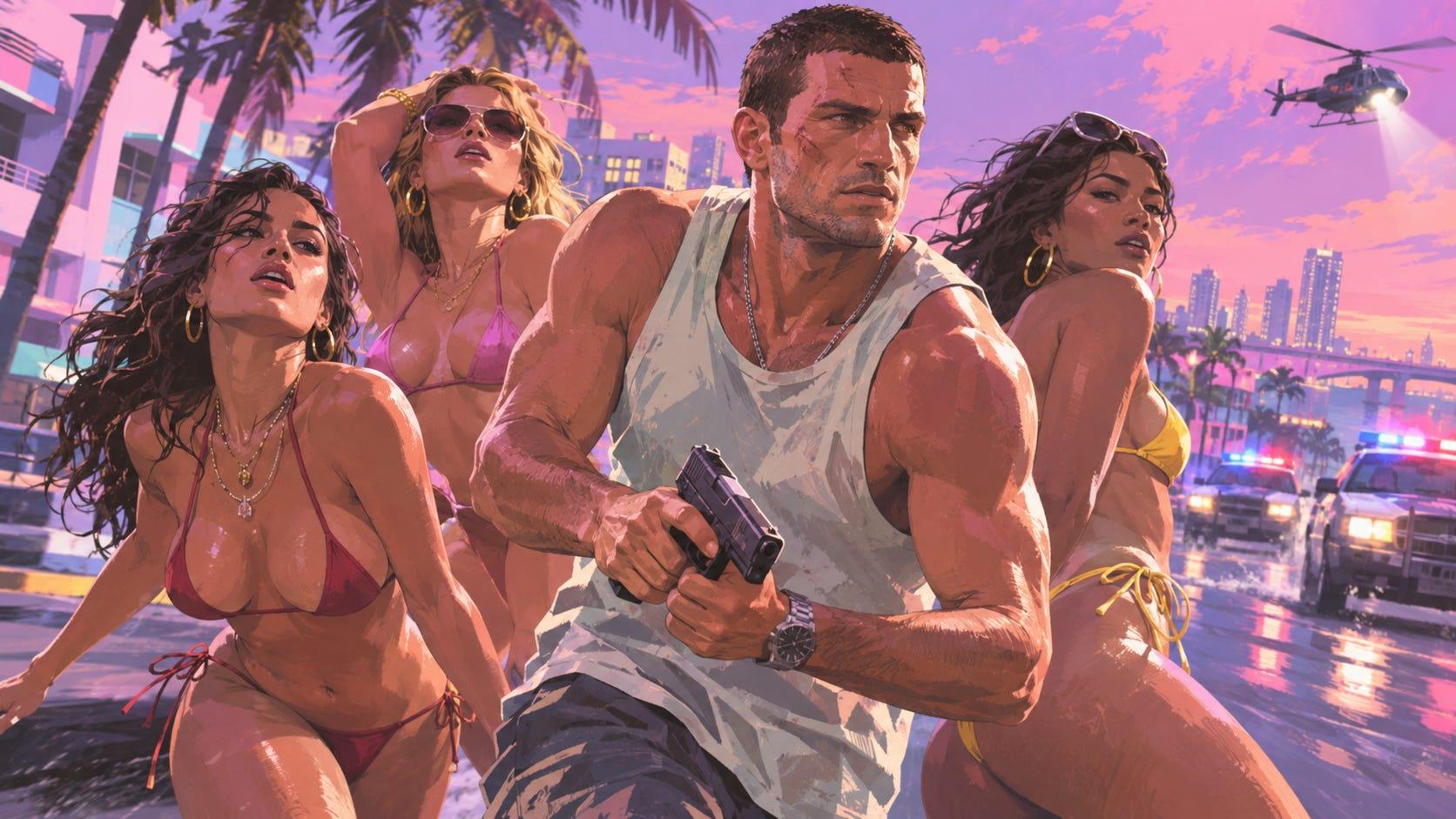
The other day I rushed out the door, pushed an old lady off her bicycle, and started pedaling to the store. On the way, I stopped to pick up a dead pelican and threw it at a dude on an electric scooter who said some really nasty things about me and my shotgun. I was tired, so I whipped out some binoculars to check out some ladies tanning on the beach.
You may be thinking I’m being clever and referring to what I did in the new video game Grand Theft Auto VI, but no, that’s just an average day in Miami for me. Due to this causing a lot of problems in my personal life — not least of them being numerous overnight stints in county lockup — I am happy to report that GTA VI allows me to faithfully re-enact my morning routine, digitally.
Since the release of the fifth entry in the series in 2013, gamers have grown up, started families, maybe even gotten jobs. Possibly due to the thirteen-year wait, these same gamers were apparently willing to forgo their newfound employment and families in order to play the game. (There have been several somewhat dubious reports claiming the US GDP could take a billion-dollar hit due to masses of gamers taking PTO).
Safe to say that video games have been, and continue to be, a big deal. The previous entry in the series, GTA V, made over $8 billion since its release in 2013. For context, the highest-grossing movie of all time, Avengers: Endgame, sits just shy of $3 billion. GTA VI has already made $3.79 billion within the first 24 hours of its release.
But this isn’t just a release of a big, fun video game. Games are now supposed to be actually important, or something. Just as The Sopranos and The Wire changed what TV could be, from cinema’s little brother to “prestige television,” video games have started taking themselves seriously too.
Which presents a bit of a problem: The series’ relevance has traditionally hinged upon a winning formula of shooting, stabbing, and exploding anything your heart desires inside of a heavily satirized version of an American metropolis. GTA has always focused on telling a good story with interesting characters too, but that always came second to providing an absurd crime sandbox to players. From the outset of the marketing for GTA VI, it was clear that the latest entry in the series intended to strike a more serious tone compared to the previous games. One where actions have consequences.
GTA VI takes place within a huge open world resembling the entire state of Florida, or as it’s called in-game: Leonida. The game’s central location, Vice City, is a scaled-down but faithfully modeled version of Miami.
There are two playable characters this time: Jason, an ex-military kinda-autistic introvert, and Lucia, a feisty Latina who looks like she would credit Pilates instead of her plastic surgeon for her proportions. Together, they are not only partners in crime but partners in kissing and hugging… and stuff, if the player so chooses. Players’ actions in-game determine if the two will be romantically intertwined.
There is a whole new layer of complexity added, not previously seen in a GTA game. The police system is massively overhauled, changing how cops can track, chase, and ultimately kill you. On top of that, there is a whole host of RPG-lite mechanics, including working out and eating to boost your stats, repairing your safe house, and a criminal profile system.
All of this is to say, the game’s scope and systems are massive. But could it possibly live up to the hype that was built for over a decade?
The World Reacts
Imagine, for a moment, you were blessed with an advanced copy of the most highly anticipated video game of the decade. When reviewing the world’s premier advanced murder simulator, do you:
Reference intersectional feminist poet bell hooks to analyze the game
Explain how playing as a Hispanic woman had you earnestly fearing in-game police brutality
Review whether the game is fun to play
As the review embargo lifted on Wednesday, I learned that some of the biggest outlets in the world had decided on the first two options.
Get 14 day free trial