
Yes, Blowing Shit Up Is How We Build ThingsDec 2
media attacks on anduril's 'failed' drone tests ignore america’s storied history of blowing up hardware to build the world’s best weapons (and win wars)
80 Likes
17 Comments
Jun 5, 2026
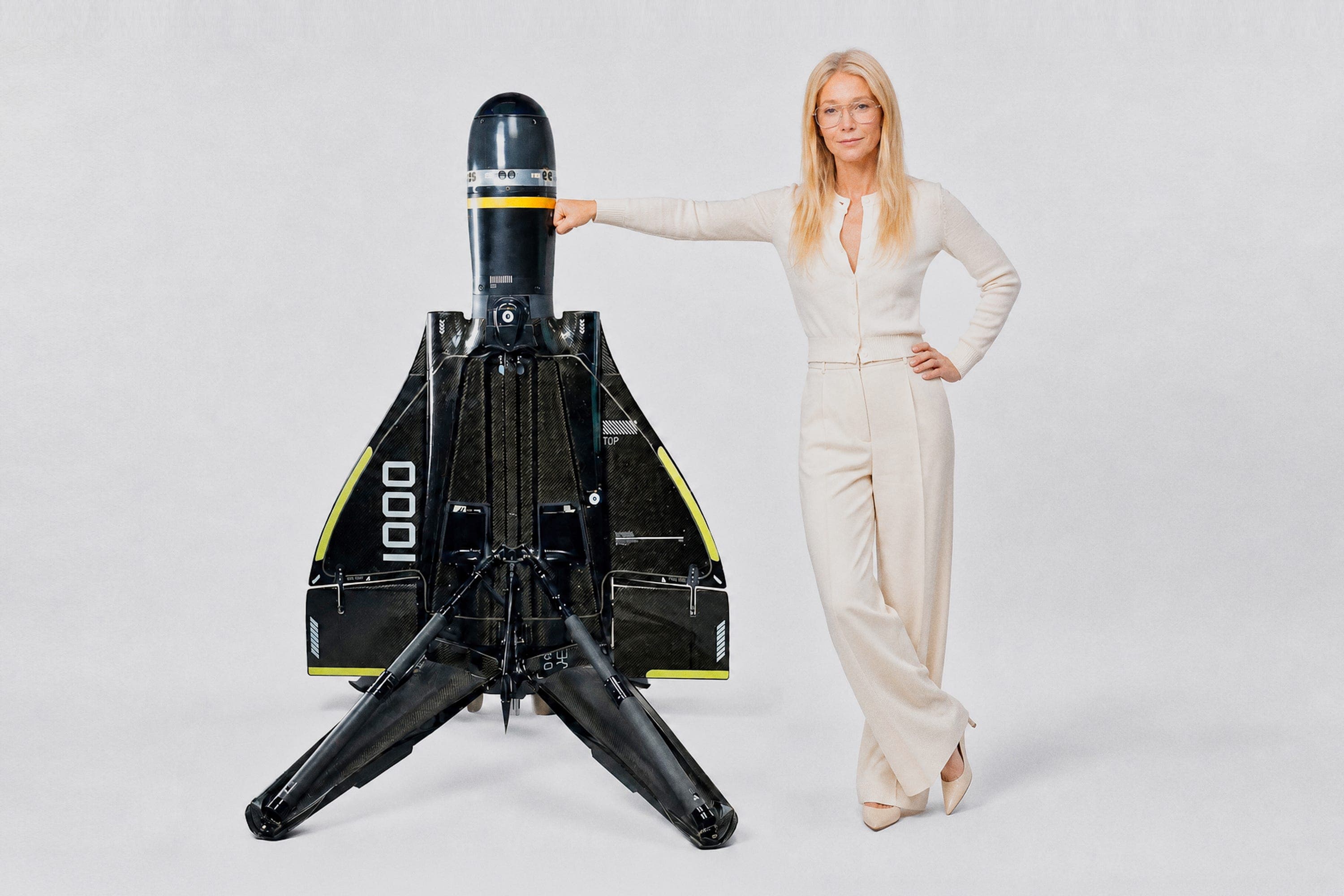
It was an unlikely meeting, a peace accord, of sorts, between defense tech entrepreneurs and woo gen-x moms who wear big fat linen pants: Gwyneth, the actress-turned-Goop-CEO, who sells Vitamin C serum and Yoni eggs to strengthen your pelvic floor, interviewing Trae Stephens, the Anduril cofounder and Founders Fund partner who spends his days, in part, building autonomous weapons for the Department of War.
Tuesday, they were sitting across a table in Goop’s podcast studio surrounded by various shades of yellow pillows. “I’ll go out on a limb,” Gwyneth begins, “and say maybe some of my Goop listeners haven’t heard of you.” (As one Bluesky poster wrote, trying to understand why this was happening… “tbf a jade egg dropped from hypersonic speed could do some damage.”)
Past guests include: dating shaman Esther Perel; protein evangelist Andrew Huberman; and Big Tech-troll Kara Swisher. Mostly, left-leaning woo girlies and wellness mamas… plus, associated “scientists” and psychotherapists — no one in defense, and definitely not anyone who’s worked directly with the Trump administration or the DOW. But this year, Gwyneth says, she’s made a commitment to be less partisan. She’s also, coincidentally, been getting redpilled and fighting with her leftist husband about it (more on that later).
Gwyn has always been a bit heretical. Her venture capital firm, Kinship, has invested in SpaceX, xAI, and OpenAI; she was an early investor in Oura. And after Goop launched in 2008, Gwyneth was accused of shilling unproven health rituals like vaginal steaming and coffee enemas. Heresy in the 2010s, I guess, meant claiming that putting a stone in your vagina could regulate menstruation (this claim got Gwyneth fined by the Santa Clara County District Attorney’s office in 2018).
In 2026, heresy looks like a liberal Hollywood star defecting from her political “side.”
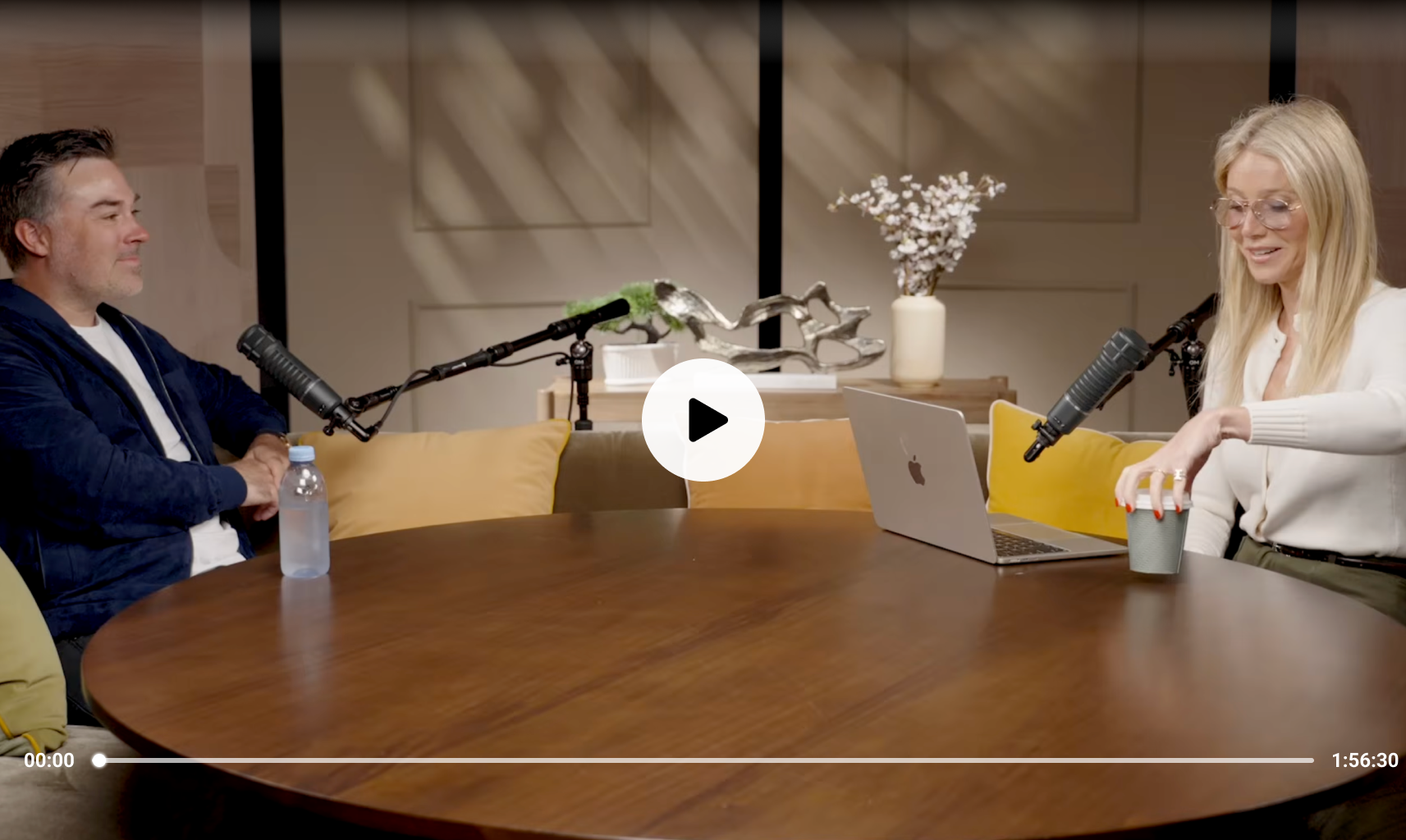
They begin with a point of agreement: America can’t build things anymore.
Trae explains that more time has passed between the SR-71 (the fastest plane ever built) and today, than between the first plane ever flown (the Wright flyer) and the SR-71. This is a failure of American industry, and American government.
After college, Trae got a job in counterterrorism. This was more boring than he expected, because bureaucracy. (It was less James Bond, more “Mr. Bean,” he says.) It was inefficient. And ineffective.
The solution (Gwyneth’s idea) is mandatory civil service. College grads should be forced to work for the government, briefly.
If 22-year-olds saw our crippling governmental bureaucracy up-close, by actually working within it, they’d be far less likely to hate it and more likely to fix it. (“Tribalism,” they both agree, is really just a reaction to governmental dysfunction.)
Gwyneth then mentions her leftist husband, Brad Falchuk.
(He once tweeted, years ago: “I want every Trump voter to have him come run their businesses and date their daughters and be their financial advisor and babysit their grandchildren and look after their elderly parents.”)
Gwyn: “I notice with my own husband, too, who’s the best person ever in the world,” she caveats (because she’s about to very kindly chastise him, indirectly), “he’s so progressive, he has such a sweet heart, and he wants to make sure everybody’s looked after.”
Pause.
She looks down for a sec, and continues. “In this climate, sometimes I [say to my husband], ‘Can you just listen to this?’” (“This” being anyone he disagrees with politically.) “[Politics] is very triggering” for him, Gwyn continues, slightly agitated and gesticulating, “It’s become so binary.”
It goes without saying that Brad probably wasn’t thrilled to hear that Gwyn is interested in Anduril.
She flashes a million-dollar smile, and then: “My husband thinks I’m a Republican.” They both start laughing to ease the tension (!) and Gwyneth very quickly and diplomatically caveats: “I’m not a Republican! I don’t feel [like I’m] anything right now, to be honest...” She calls herself a “centrist.”
(Is Gwyneth Paltrow “heterodox”?)
But if you don’t hear out people you disagree with, they agree, there’s no “friction.” And “friction is where character is built,” says Gwyneth.
“We’ve relied on nuclear deterrence against great powers for almost a century,” explains Trae. Gwyneth nods as he explains “mutually assured destruction.”
“War games,” Gwyneth says, sipping coffee. (Or possibly hojicha.)
Earlier in the interview, she describes moving to NYC in 1984 and being “petrified” that Russia would bomb the city. She never really felt safe in the U.S. — and, famous at a young age, she always felt like there was a target on her back.
Which explains her interest in Anduril.
How can we keep ourselves safe? she asks Trae.
Nuclear deterrence, Trae explains, is no longer enough, because as we’re seeing in Iran, Ukraine, and Israel, it doesn’t prevent deadly and protracted conflict. The only way to prevent it? Non-nuclear deterrents, like drones and interceptor missiles. Which we have to make cheaper, and more precise, with AI.
Today, Trae says, just as one example, we’re firing 80s-era Patriot missiles at Iranian drones. Iran’s drones are small, they cost tens of thousands of dollars to make. A patriot missile costs $2.25 to $8m every time we fire one.
Gwyneth, nodding: “I saw Top Gun.” (She gets it.)
Trae: “So, every time one of those [cheap Iranian drones comes in] we’re shooting at it with a multimillion-dollar missile.”
Gwyn: “Currently?!?”
Trae: “Yes, and this is completely impractical.” (We’ve fired thousands of these multimillion-dollar missiles in Iran just this year.)
Hence: Anduril’s goal, which Gwyneth now understands, to build robot interceptors that use AI and computer vision, dramatically lowering the cost of shooting down enemy drones.
“I’ve always pushed back and questioned things,” Gwyneth says, referring to her ever-in-flux belief system. (Again, she’s a lowkey heretic.)
Trae poses a dinner party question: What is one thing you believe that would be upsetting to your peers? For most people, it’s hard to answer. And if you can’t answer it, you have to wonder, do you really believe anything at all?
He goes on to explain how people think of Silicon Valley as a “free-thinking” place, when really, people often just copy each other. “[Silicon Valley] was super progressive [in the 2010s], and now there’s this turn to traditional religion. They went from being very against defense tech to being hyper for defense tech…”
And in a mimetic industry, you must be even more vigilant about why you do or don’t believe things. Do you believe it just because it’s comfortable? Do you want something only because people you admire want it?
It’s interesting, actually, that he’s talking to Gwyneth about this, because her entire ~$200m wellness empire runs on mimetic desire. Goop devotees want what she wants — whether that’s a peptide cream or a “vagina” candle. In response to Trae, Gwyneth defends the idea of mimetic desire (her whole business): “I think inspiration is such a beautiful quality,” she says.
Trae concedes, she has a point.
…as long as you’re choosing good models, he adds.
The conversation turns to faith, specifically Trae’s self-described identity as “the Christian guy in tech,” a label he never really thought he’d have — until, about a decade ago, when he joined Founders Fund and seemed to be the only guy willing to talk openly about loving Jesus Christ. (His dad was a pastor; he grew up going to church every Sunday.) And his colleagues, other guys in tech who had money and power but “something missing,” were curious.
“My friends who have faith,” Gwyneth says, “have this thing that I don’t have that I’m sort of, like… I don’t think jealous is the right word, but I want to understand it more.” (Her dad is Jewish, her mom is Episcopalian; she didn’t grow up religious. Her religion, if anything, is probably “wellness.”)
After a wide-ranging conversation about why tech now loves Christianity (“is it just because it’s right-coded?” Gwyn asks, and Trae is like: no, it’s because people didn’t find what they were looking for in Silicon Valley’s LSD-and-polyamory era…), and their close relationships with their fathers, both of whom died when Gwyn and Trae were each 30 years old — Gwyneth asks one last pointed question on behalf of her “very progressive” husband.
It’s a question “my husband asks a lot” (of people working with the Trump admin), she says.
“If you read the gospels,” Gwyneth begins, “Jesus is very unambiguous around, the meek shall inherit the earth and love thy neighbor as thy self. And in our [political] climate right now, some of the rhetoric is… not that.”
Pause.
“How do you hold those things at the same time, as someone who worked in the Trump administration [Trae served on Trump’s 2016 transition team, and Anduril’s primary customer is the DOW]? How does that work?”
Again, the TDS Husband silently enters the room, metaphorically. (Is Gwyneth Paltrow having a proxy fight with her husband, through Trae? I wondered.)
Trae describes an imaginary quad chart. Some things feel good and are good (healthcare); other things feel good and are bad (porn, gambling); some things feel bad and are bad (child sex trafficking). But then, there’s the hardest quadrant to reckon with: things that feel bad but are good.
Things like: Law enforcement. Duty. Responsibility.
Trae: “I’ve spent my entire career working in defense. [...] This belief that we’re hard-charging [warmongers]… throwing people as meat bags into combat zones… it’s just not true.”
And while he’s not, personally, a fan of some of the hyperbolic rhetoric in use today, Anduril’s core goal is saving lives. Deterrence.
America needs to build up a “capability advantage” over China and Russia through the next 100 years, Trae says. We desperately need lower-cost, non-human-operated — autonomous or semiautonomous, i.e. AI-assisted — weapons that can execute missions precisely and at no risk to American lives. Do you really want to send a manned missile into battle every time you need to shoot something down? We need better war technology, he argues, and the will to deploy it.
As for building weapons as a Christian, Trae invokes Saint Augustine’s “just war” theory. Sometimes, war is justified to defend your allies or yourself, and to create a lasting peace.
Jesus’ teachings, Trae says, speak to the “condition of your heart.” They’re personal. They apply to individuals, not to nations. And it is possible, per Trae, to approach war with a “heart of peace.”
“If you’re measuring your greatness in the size of your conquest,” he says, “you’re not going to be in a good place. But if you’re measuring your success in the peace you create long-term,” and building “a society that respects law,” then conflict may be just. Even if it doesn’t always feel good.
—Harris Sockel
media attacks on anduril's 'failed' drone tests ignore america’s storied history of blowing up hardware to build the world’s best weapons (and win wars)

the pentagon has wanted war ai since vietnam. this is how palantir built it.

tech companies give the government, historically dumb and slow, cutting-edge tools to enforce the law of the land. don't like it? change the law, don't blame the toolmakers.

ready player one. what did you get done this week?

lulu cheng meservey shares the never-before-revealed playbook that shaped Anduril’s early communication strategy and helped its founders turn the company from black sheep to household name
despite anthropic frustrating the admin with its blogging and very slow 'politburo' of ethicists, emil michael, the pentagon’s head of ai, says he’s still ‘open’ to a deal