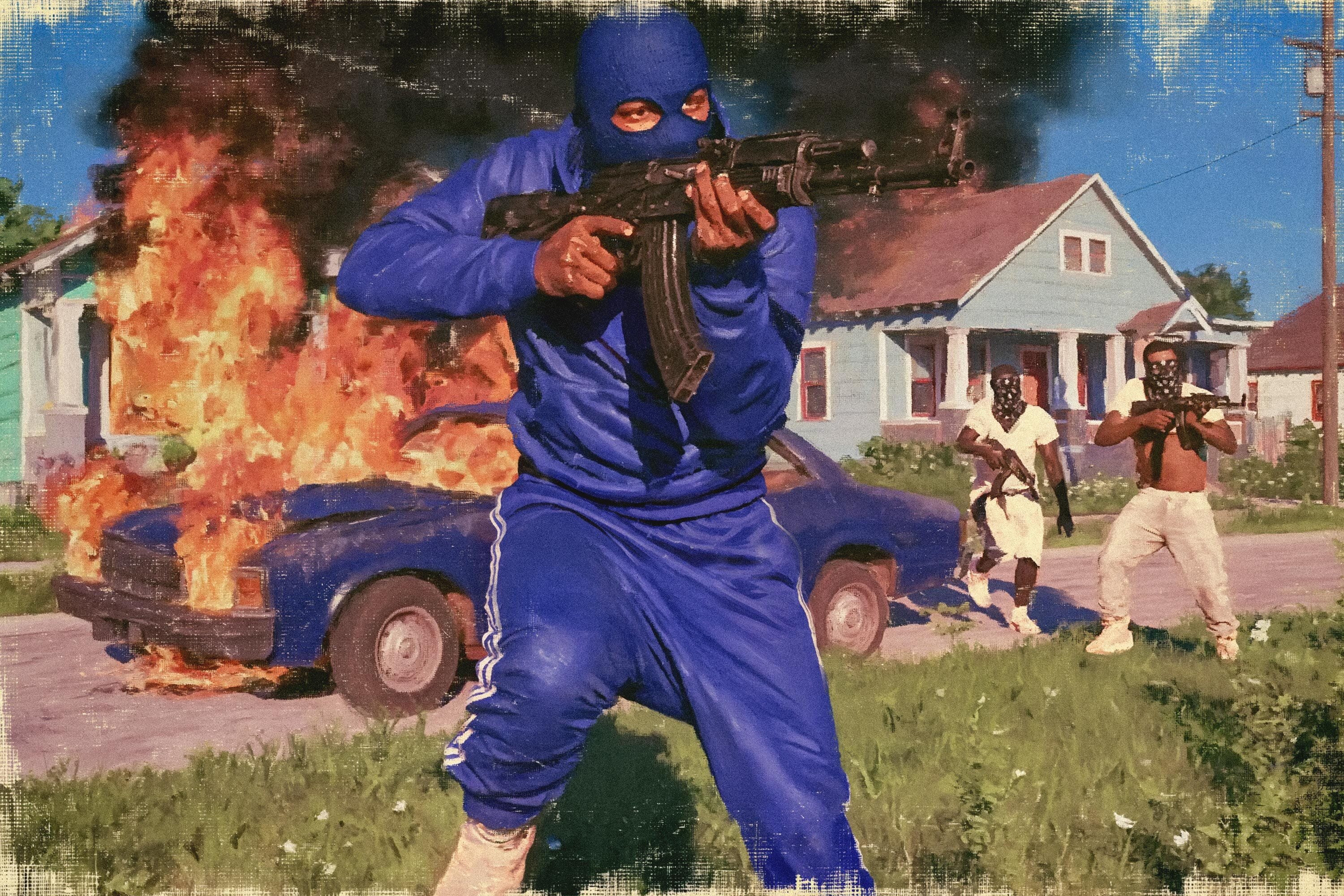
Leaping behind an abandoned house, I didn’t make a sound. I heard footsteps coming down the alley. “Where’d that n*gga go?” I shuddered as I heard one of my pursuers saunter closer to the back of the house, reloading his choppa. “Ain’t getting away that easy white boy!” a shrill voice cuts through my headset. He thunders around the corner and my avatar dies in a flurry of bullets and racial epithets. I sit back in my chair, knowing I just cost my gang the game, exasperated. More verbal assaults erupt from voice chat at my choking away the final round of Destroy the Block.
This is my experience playing Hood Warfare 2, the viral first-person shooter released by indie gaming studio Trapstar Games in early October. Modeled on the classic Call of Duty games from Gen Z’s childhood, Hood Warfare 2 replaces the sleek operators of elite military units with local Blood and Crip gang members as they battle for control over South Side Chicago, known as Chiraq. Instead of Delta Force hardware and cutting-edge killstreaks, your gang avatars fight for control of various urban environments with Glock switches, AK-47s, and killstreak rewards like drive-bys and homie reinforcements.
A game this on the nose about urban crime would have been unthinkable just a few years ago. What changed? In late 2024, talking heads on the Left and Right pointed to a “vibe shift” post-Trump’s second election, in which the cultural Overton window shifted so extremely that previous taboos and sacred cows could be openly discussed and routinely mocked by elites and common men alike. It was, we were told, the culmination of a backlash against woke hysteria that penetrated every sector of American culture.
Every sector, except the gaming industry.
This isn’t exactly surprising. The rise of trans has resulted in dudes who are game coders or designers, and maybe just a bit on the spectrum, trooning out to conform to an industry that has prioritized “marginalized” groups since GamerGate. For those out of the loop, GamerGate erupted in 2014 when a female gaming journalist was alleged to have been romantically involved with the developer of a game she was reviewing. It snowballed into criticism from gamers regarding gaming journalists’ trustworthiness and concerns about attempts to politicize, feminize, and race- and gender-swap characters in a range of games (this is called foreshadowing).
Look at recent history: land acknowledgements in games, characters forced into “girlboss” narratives, and entire divisions of LGBTQIA2S+ pressure groups dedicated to naming, shaming, then consulting with gaming studios on how to add more gay shit into their products. The most militant group is Sweet Baby Inc. (SBI), an “inclusion-focused narrative and consultation company,” whose client list includes almost every major game studio. SBI’s accomplishments span the entire rainbow: “memorializing queer love” in God of War: Ragnarok by introducing the series’ first gay character and parachuting a black guy into Norse mythology; crafting dozens of queer, nonbinary, and amorphous blob waifu heroes in Overwatch 2; and creating “romantic yearning” between nemeses Wolverine and Sabretooth in Marvel’s Wolverine. SBI also listed Valve — the company that runs Steam, which controls north of 75 percent of the market for selling PC games — as an official client in early 2024.
This is the digital and cultural landscape in which Hood Warfare 2 landed with a bang. A game where the racial slurs in-game are just as plentiful as those coming through voice chat, Hood Warfare 2 will feel immediately familiar to anyone who grew up playing Call of Duty between 2008 and 2012. This gaming experience is full of nostalgia, as I can attest. After about 40 hours blasting away at the opps in every gamemode, I can safely say that Hood Warfare 2 harkens back to a simpler era of gaming where handholding was minimal, voice chat was everywhere and uncensored, and even coughing into the mic risked an explosion of music spam, screeching, slurs, shouting, and arguments from across the lobby. It was amazing.
Get 14 day free trial