What Happened to the American Cinematic Universe?Dec 18
cold war II is a culture war, too
10 Likes
5 Comments
Sep 14, 2026
Madeline Hart is co-author with Palantir CTO Shyam Sankar on the book Mobilize, published March 2026.
Men read less fiction than women. Exactly how much less is subject to debate, but conservative estimates find a roughly 20-percent gap that’s persisted over a decade.
Walk into any Barnes & Noble, and you’re immediately hit with a kaleidoscope of pastel covers, each adorned with some variation of 2D cartoon art and a girly typeface. And that’s just the fiction table up front, before you get to “romantasy,” a booming genre filled with poorly written stories about hot alpha males lusting after awkward nerdy girls, give or take a dragon (hard to say which part’s the fantasy).
A viral New York Times article last year admonished men for not reading more fiction, and noted that men who do read fiction are rare, and hot. (“It was one of the most erotic things I ever heard. A man I know said he was reading all the novels of Jane Austen in one summer.”) But, clearly, if men don’t read fiction, it’s not because they’re dumb, unimaginative, or unenlightened — it’s because what’s on offer isn’t all that attractive to them.
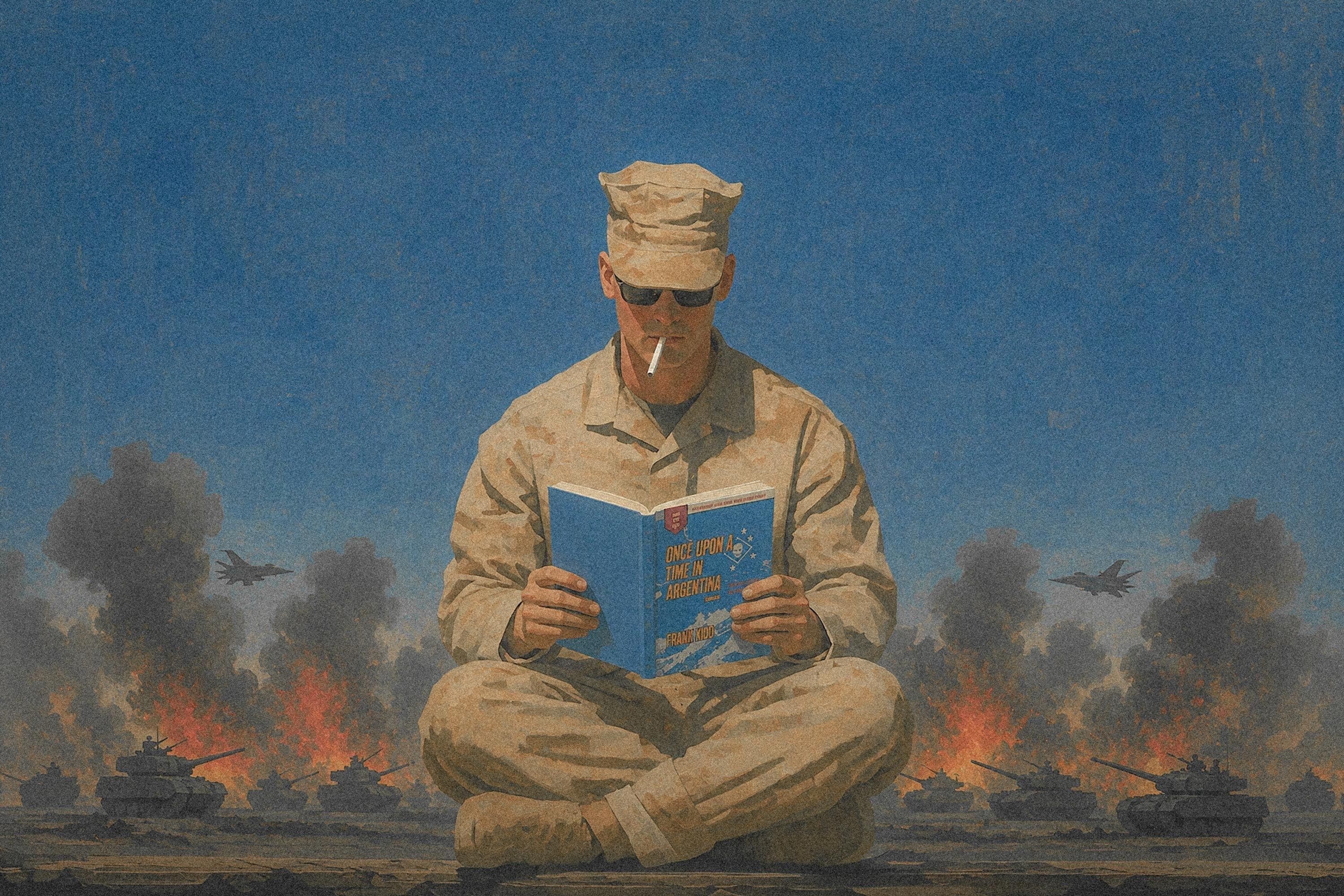
The industry essentially stopped publishing novels for men, a state of affairs that is boring, even for many women — which is why it was so refreshing to pick up Frank Kidd’s 2026 novel, Once Upon a Time in Argentina. In this masculine book written by a man, a group of seven American private military contractors are unleashed on illegal Chinese fishing operations off the coast of Argentina.
Yes, Kidd’s novel is self-published, and yes, it’s good.
The book opens with our protagonist, Ryan McGowan, in a Houellebecquian malaise. Despite living in sunny California, this former Marine Raider turned cubicle lackey counts suicidal ideation as his primary hobby. He’s not suffering from PTSD so much as from the effects of a castrated society. HR culture is stifling him. His boss is a literal cuck. He’s forced to sit through a DEI training that manages to be David Duke levels of racist.
If this were a Houellebecq novel, our anti-hero would continue to spiral. But we’re in Kidd’s military thriller! Ryan joins forces with a shadowy figure and his merry band of ex-military misfits. The job comes with fresh passports and cover identities, courtesy of their mysterious ringleader, and they fly to Ushuaia, the Patagonian town long known as “the end of the world.” Ryan learns of the mission (hint: it involves China) only when he’s too far south to turn back.
Here in the real world, Chinese illegal fishing is a well-documented problem. Under the United Nations Convention on the Law of the Sea (UNCLOS), to which China is a party, foreign vessels are forbidden from fishing in a country’s exclusive economic zone (EEZ) without authorization. But China, having depleted its own waters of fish, operates a CCP-subsidized global network of at least 16,000 fishing vessels. They illegally harvest squid, tuna, endangered sharks and whatever else the trawl net scoops up from off the coast of Argentina, West Africa, and (according to some estimates) up to 90 countries worldwide.
As the meathead of the group in the novel puts it, looking out at these CCP-subsidized fishing boats near Ushuaia: “They call it the City of Lights. It literally looks like a floating city from space... a motherfucking flotilla of huns here to suck the oceans dry.”
cold war II is a culture war, too

media attacks on anduril's 'failed' drone tests ignore america’s storied history of blowing up hardware to build the world’s best weapons (and win wars)
there's a new book out about incels — here's our review

how the u.s. fell dangerously behind china on drones — and what that means for the future of warfare
there’s a new video generation champion in town, and it ain't american. here's why seedance is so weirdly good, and what it means for the future of the ai arms race.
a group of x-rated gay artists are returning rap to its politically incorrect roots — and amassing millions of (mostly straight) fans in the process