
Inside Xavier Becerra’s $782 Million Migrant Sleepaway Camp From HellSep 21
the california dem candidate for governor once funded a $92,608-per-cot migrant facility that may have sent kids to trafficking rings
49 Likes
15 Comments
Sep 28, 2026
In 2025, 5,842 people in Los Angeles exited interim housing back to the streets, up 24% from 4,708 in 2024. These facilities are mostly taxpayer-funded but run by private nonprofits; last year alone, Los Angeles spent roughly $319 million on its interim-housing system.
Officials and shelter operators have largely blamed these departures on the shortage of permanent housing and rental assistance. “Some people just get tired and say, ‘I’m done. I’m leaving,’” Ken Craft, chief executive of Hope the Mission, an LA nonprofit that operates interim housing programs, told the Los Angeles Times, describing residents discouraged by the wait. The Times also cited residents who left for want of fewer rules or easier access to friends and drugs, along with those who were simply kicked out.
But while reporting on dog abuse on Skid Row, homeless residents kept telling us that the reason they left interim housing was because of the conditions and treatment inside (a phenomenon that’s previously been reported by CalMatters).
Tracy, a homeless woman we spoke to, called it “jail”; another told us, unprompted, that guards had beaten him repeatedly.
Again and again, Skid Row residents described abuse by security guards in these facilities.
Casey, a woman staying in the Weingart Center, an interim housing facility on Skid Row, told Pirate Wires that a uniformed, on-duty Weingart security guard touched her without her consent while she stood in line at a market across the street. “I reached in my back pocket to get my money out,” she said. “He put his hand in my back pocket, too.”
Another formerly homeless woman, now Skid Row caseworker, who wanted to remain anonymous, told us a guard pushed her while she was housed at the LA Grand (a hotel converted to interim housing as part of Mayor Bass’s “Inside Safe” program) after she yelled at security to call 911 for a resident who appeared to be having a stroke. She said the guards then pulled off their shirts and challenged her: “What are you going to do, bitch?”
Roger, 61, also recounted abuse from security guards at the LA Grand, saying they’d beat him to the floor. “They’ll threaten your life,” he said. “They don’t like people from the streets.” When I asked if he felt safer on the street than in an Inside Safe facility, he answered with an unequivocal “yes.”
Among California lawsuits reviewed by Pirate Wires — brought by residents of publicly-funded homeless shelters against shelter operators, security personnel, and, in some cases, the Los Angeles Homeless Services Authority (LAHSA) — sexual misconduct was among the most common allegations.
We found some cases particularly worrying.
Three women accused the same security guard at the interim housing facility called A Bridge Home at JD’s Place, back in 2020, of assaulting them during a single shift. One said he reached under her clothes; another said he assaulted her as she dressed after a shower; a third said he propositioned and groped her.
In 2023, at A Bridge Home Riverside (a 100-bed interim homeless shelter), a resident named Shannon alleged that a guard grabbed her wrists and forced her hand onto his genitals.
In 2024, at another interim housing facility called Mercy House’s Huntington Beach Navigation Center, outside Los Angeles County, Leyla said a guard made sexual comments to her while she was preparing to do yoga. Staff then moved him to the front entrance after telling her he would no longer be assigned to the shelter, but four days later, he returned to his post outside the women’s dormitory and confronted her: “I hear you’re the one that doesn’t like me.”
Other complaints described physical violence. Eddie, a resident of A Bridge Home in Venice, alleged that a guard assaulted and pepper-sprayed him without provocation. Kenneth said an officer at Hotel Solaire threw him down and punched him roughly 30 times after accusing him of stealing a bicycle. At the Testimonial Community Love Center, Ramon alleged that a guard fought a resident while several other guards stood by.
Incident reports obtained by Pirate Wires from LAHSA, which funds and oversees facilities throughout the broader Los Angeles County, also documented several confrontations involving shelter security guards.
At The People Concern’s Turning Point shelter, a staff member reported hearing a security guard threaten to remove two residents and challenge one to “take this outside.” She later found the guard on top of the resident. Another report, from a Volunteers of America facility in North Hills, recorded a resident’s allegation that a guard tried to kiss her in an elevator. The guard denied it, and the report characterized the allegation as false, but documents no further investigation.
Even when allegations are documented in official records, responsibility is difficult to pin down because the guards work for outside contractors that are then hired by the interim housing facilities.
Kat Calvin, an attorney and former Skid Row service provider, said the contracting arrangement appealed to operators for two reasons: “A, they’re less expensive. B, it significantly reduces the liability of the organization.”
LAHSA said in an August 2024 report that most interim-housing sites use independent security companies with separate training protocols. (Allied Universal was the company most frequently identified by residents we interviewed, while Citiguard appeared most often in the lawsuits we reviewed.) And while the agency will track incidents involving physical assault, police involvement, property damage, and staff misconduct, and several other broad categories, it does not track whether a security guard was involved. Imposing “higher standards of training and/or performance expectations,” LAHSA wrote, would require “additional funding.” (LAHSA’s 2025-2026 budget was $829 million.)
Justin Szlasa, a member of LAHSA’s 10-person governing commission — the agency’s top oversight body — and former chair of its audit committee, where he pushed for tougher scrutiny of LAHSA’s spending before being removed without explanation, told Pirate Wires that “across the board, I think our programs would have better outcomes if we did a better job with security.”
“When unhoused people go inside, they must feel safe,” he said. “Security guards are central to that.”
To be sure, the guards are under enormous stress. They’re in charge of order in an environment that is inherently disorderly (picture residents on drugs taking poor care of dogs who create “biohazards” in the rooms) — while making about $18 to $22 an hour (according to public job postings).
Per Calvin, the field staff at her nonprofit, who were “usually some of the higher paid” frontline workers in Los Angeles’s homeless-services system, made around $50,000 a year — hardly enough to live comfortably in Los Angeles.
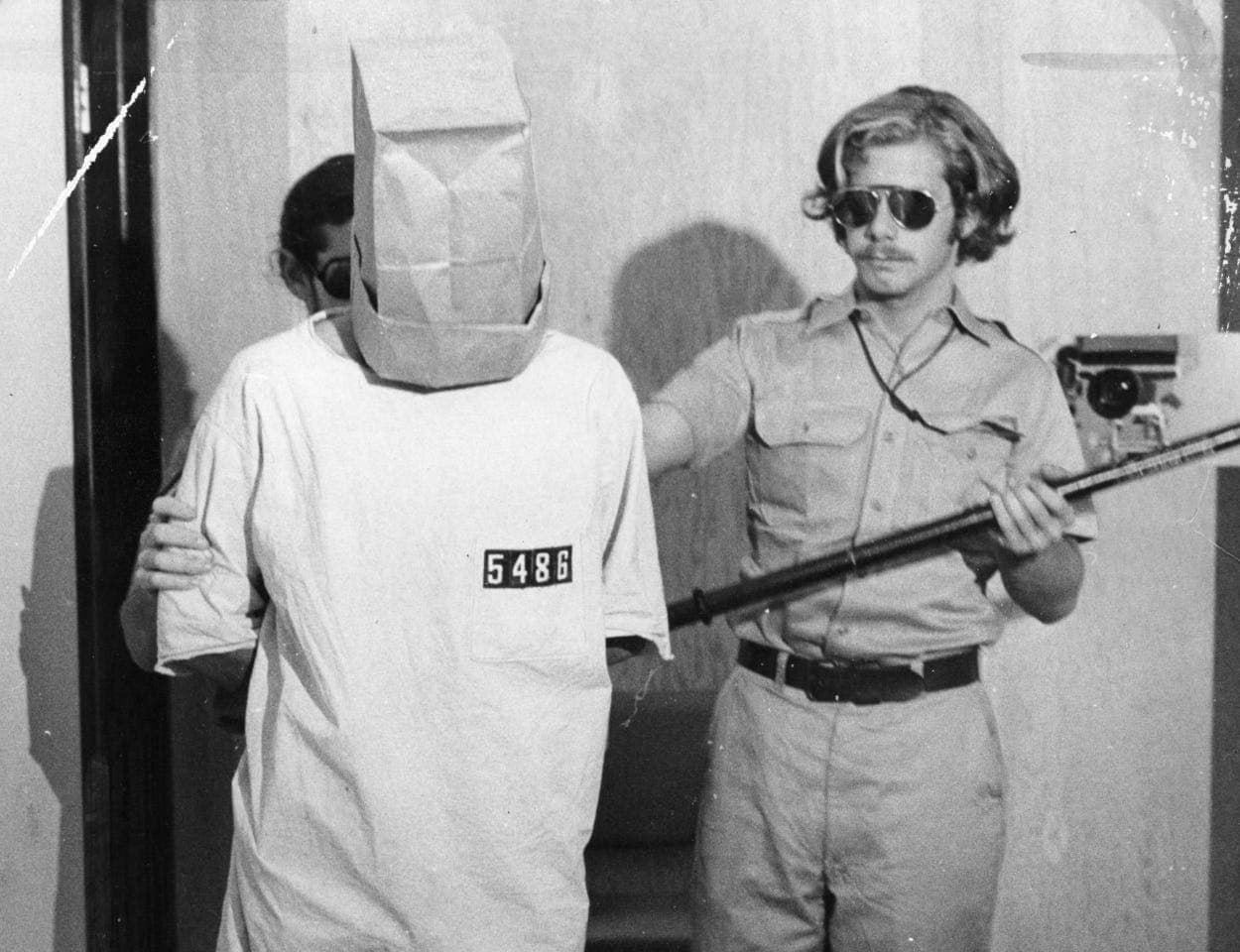
Between the low pay, high stress, and nearly absolute authority over people who are sort of helpless, conditions across these shelters in Skid Row and beyond are reminiscent of the Stanford Prison Experiment’s.
Without the “higher standards of training” that LAHSA said would require additional funding — or centralized tracking and clear lines of authority — Calvin said, “it leads to a lot of abuse of power. It leads to violent situations.”
And when those situations occur, the fragmented structure works in everyone else’s favor.
Caitlin Rose, who managed LAHSA’s portfolio of more than 8,000 interim-housing beds from 2020 to 2021 before leaving in frustration with the agency’s disorganization, gave Pirate Wires a similar explanation: “Everyone hires these contractors because they’re cheap, and it’s a way to avoid responsibility if something happens: ‘It’s not my fault — I didn’t hire them.’”
When I told her about my abuse findings, her response was “I’m not surprised.”
— Nicole Wizman
If you have firsthand knowledge or records of abuse inside LA’s housing facilities, send Nicole a tip on the encrypted app Signal at +1 424-387-6009.
the california dem candidate for governor once funded a $92,608-per-cot migrant facility that may have sent kids to trafficking rings

we spent a day on los angeles’ skid row, where we saw pubes, butts, barefoot kids walking around needles, dogs with broken legs, lost puppies, and illegal breeders

as city council homelessness chair, raman greenlit hundreds of millions of dollars for programs she *knew* had issues, failed to catch rampant waste, and watched homelessness rise

ceo garrett langley discusses the promises (finding 1,100 missing people; apprehending murders) and pitfalls (creepy cops stalking exes) of his 120,000 cameras

pirate wires #163 // palmer luckey vs. paul graham on american labor, unpacking the h-1b visa, and how tech stumbled into the red hot center of america’s battle over immigration

manny marotta is live-tweeting the year 2001 for millions of fans on x — and he’s planning an immersive ‘simulation,’ timed down to the second, for september 11th