
How the Military Is Using Palantir to Fight WarsApr 10
the pentagon has wanted war ai since vietnam. this is how palantir built it.
123 Likes
15 Comments
Aug 12, 2026

On December 13, 2025, a masked gunman opened fire in a Brown University classroom, killing two and wounding nine. The shooter, who carried out the attack in a camera-free area, managed to escape. Days later, police got a lead on a gray Nissan with Florida plates. They ran it through Providence’s Flock Safety automated license-plate-reader network (ALPR), traced the car to a rental agency, and identified the shooter within hours. Providence officials called Flock “instrumental” to the investigation.
This, among other success stories, is largely the product of what Flock has done to a decades-old policing technology. It made ALPR cameras cheap and scalable, layered in AI-powered search (i.e “blue hoodie,” “gray Nissan”) and connected them across jurisdictions through a nationwide network. Its broader platform now includes video cameras, gunshot sensors, and drones.
Nine months later, Americans are now ripping Flocks’s ALPR cameras to the ground en masse. Cities are canceling contracts, Republicans and Democrats are pushing bans at both the local and national level, and “deflocking” has become enough of a movement that one viral post called it “the closest Americans have gotten to the Boston Tea Party since 1773.”
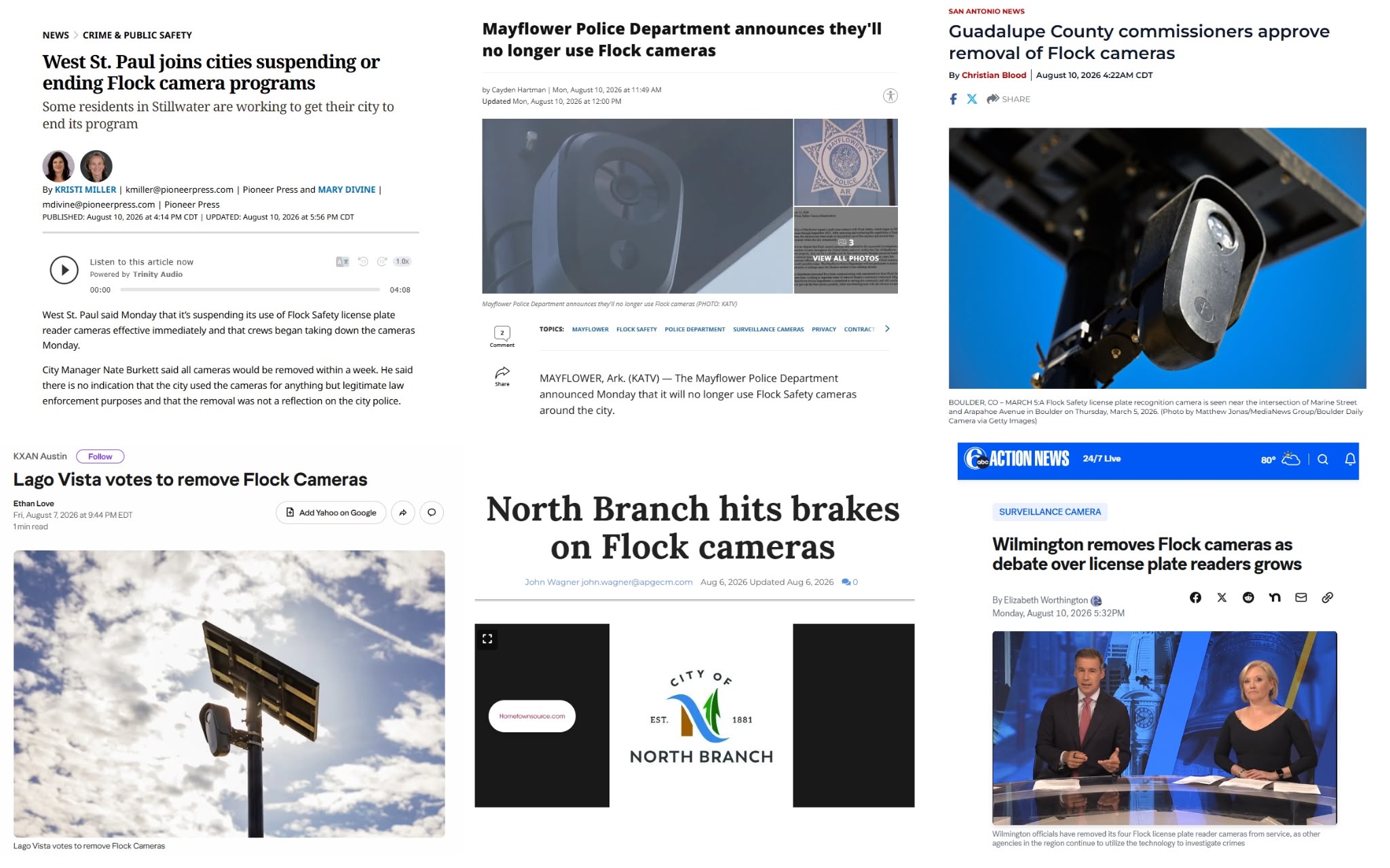
The backlash stems largely from some pretty ugly stories about how Flock’s system is being used.
During probably the worst two-week stretch of press in Flock’s history, founder Garrett Langley gave Pirate Wires his side of the story — why the technology works, where the abuses come from, and whether America can have Flock without becoming a surveillance state.
We started with the obvious question: does this stuff actually work?
According to Langley, yes. “In July alone, [Flock] helped detect roughly 1,100 missing people, 6,000 felony warrants, and more than 20,000 stolen vehicles” nationwide.
“There’s really no debating the efficacy of the technology,” he told me
A primary reason for that success — and, simultaneously, people’s fears about the tech — is Flock’s enormous scale. Its network spans more than 120,000 cameras across 6,000 communities, generating roughly 20 billion plate reads a month.
That’s a lot of flocking data.
Who owns it?
“The customer owns the data,” Langley told me. (Customers including local police departments, cities, homeowner associations, businesses, etc.)
Can Flock access the data? “Nope.” Does Flock have access to the camera at all? “It’s our customers that have the control,” Langley added.
Ownership aside, there’s still the question of retention. With that much data, how far back can police rewind someone’s movements? Where they live, where they work, where they worship, even who they may be visiting.
Thirty days is the default. But local governments can change that. “Worried about mass surveillance?” Langley asked. “Reduce your data retention down to seven days, five days, one day… you should do what you think is right for your community.”
Some do. Austin cut its retention period to seven days over privacy concerns. Lexington, Kentucky, doubled it to 60 days to give detectives more time to investigate cases.
However, most Flock communities keep the data for 30 days, potentially giving police a searchable month-long record of someone’s routine and movements if enough cameras capture them.
I brought up Norfolk, Virginia, which currently has 176 city-operated cameras spread across 75 locations; police can also access another 43 privately-operated Flock cameras in the city.
In 2024, two residents sued, arguing that the city’s warrantless use of its Flock ALPR network constituted an unreasonable search under the Fourth Amendment. Their theory was that, although any single camera sighting on a public road may be innocuous, aggregating enough of those sightings can reveal the “whole” of a person’s movements over time.
Langley wasn’t particularly worried.
“There’s been over 40 court hearings on the constitutionality of LPR, both before Flock existed and now,” Langley told me. His argument is that Flock captures discrete, point-in-time images of vehicles (and license plates) on public roads — information already exposed to public view — rather than continuously tracking a person’s location.
“You’re driving on a public road,” he explained. “You get out of your car and start walking. [We would] have no idea where you are.”
So far, the courts have agreed with Langley’s logic. In January, a federal judge ruled that Norfolk’s system did not violate the Fourth Amendment, finding that its cameras were too scattered to chronicle the entirety of a person’s movements.
But the judge left open a fairly important caveat: as ALPR networks grow, there may come a point where they become intrusive enough to cross the constitutional line. In Norfolk, the court concluded, that point is “not today.”
The networks, meanwhile, are getting more sophisticated. Flock Safety started expanding beyond license-plate readers in 2021 — first with gunshot detection, followed by fixed video and, after acquiring drone startup Aerodome in 2024, drones (which, unlike ALPR cameras, can hypothetically track one walking down the road).
“We will never weaponize our drones,” Langley told me. “They will [also] not be used for broad surveillance.”
Keeping a drone constantly in the air to surveil people, he added, “has already been proven to be unconstitutional, so we are not going to do that.”
What Flock will do, however, is use drones to get eyes on a scene faster.
After being dispatched because of 911 calls or license plate hits, the drones stream live video directly to officers.
“Here’s a good example,” Langley said. “In Everett, Washington, there was a 911 call of a man with a gun. Scary, right?”
“So if you were an officer, your response is going to be, ‘I’m coming in guns blazing, adrenaline rush. There’s a man with a gun. I’m ready to go do something.’ Well, the drone gets there first. Guess what? It wasn’t a gun. It was a lighter.”
In that case, the drone made both the officer and the civilian safer by showing police what they were actually walking into.
The company’s national network — where participating agencies can use “National Lookup,” a Flock feature, to search data from other departments’ cameras — raises another set of concerns.
In Texas, a Johnson County deputy allegedly searched 83,345 Flock cameras nationwide for a woman after authorities received a report that she had self-administered an abortion, reaching into states like Washington and Illinois, where abortion is legal. In Wisconsin, deputies used Flock to reconstruct a wanted man’s trips into marijuana-legal Michigan and back, then cited those trips as part of the probable cause for searching his car for weed. In Florida, wildlife officers (trained and deputized by ICE) reportedly ran dozens of immigration-related searches across more than 5,000 participating Flock networks nationwide on ICE’s behalf.
The Texas case, in particular, became a rallying point for civil-liberties advocates, who argued it showed how a nationwide ALPR network could allow one state to effectively extend its enforcement priorities far beyond its borders.
According to Langley, and, apparently, a Texas sheriff’s department report, the reason for the Flock search was to find the woman upon suspicion that she was in danger from her violent ex-boyfriend, who’d made up the abortion report after attacking her.
At any rate, National Lookup, Langley stressed, is opt-in. “You’re not forced to join,” Langley told me. “It is something that cities should pick and decide.”
California, for example, “decided they don’t want to participate because they don’t want to share ALPR data.” State law bars local agencies from sharing ALPR data with federal or out-of-state law enforcement, a restriction that has become especially salient amid concerns over ICE access. “That’s perfectly within their rights,” Langley said. “We accept that, and they’re not privy to the national network.”
Still, some of the most heinous, violent crimes span state lines, Langley said: “Having a quick ability to run a tag so far has proved to be very valuable.”
In Utah, Flock’s ALPR network helped track an armed triple-murder suspect across three states before his arrest in Colorado. In another case, authorities used Flock to locate a North Carolina ex-police officer allegedly traveling to carry out a mass shooting (targeting black people) in New Orleans at a Florida hotel. And in Arkansas, a Flock hit helped police capture a suspect wanted in connection with a double murder in Texas. Not to mention the Brown Shooting, whose manhunt spanned New England.
Of course, a powerful search tool is only as trustworthy as the person using it. And some officers have used Flock for decidedly personal reasons, allegedly tracking ex-wives, partners, romantic rivals, and other people in their private lives, giving Americans another reason to worry: if an officer can use the system to stalk an ex, what stopping the establishment from searching anyone they want without a legitimate investigative purpose?
“It’s horrible,” Langley said. “I think it’s disgusting that people who carry a badge… choose to abuse their power to target ex-wives or spouses or partners.”
But he argues those cases say more about bad cops than bad technology.
Flock has logged every action taken in its system since the beginning. The problem, Langley said, was that large departments accumulated so much audit data they didn’t know what to look for to stop abuses. Four months ago, Flock built a tool specifically to flag potential abuse.
So the recent spike in misconduct stories does not worry him in quite the way critics might expect.
“Police abuse has existed forever,” he said. “We are shining a light on [the fact] that there are bad actors.” He added that most departments want those officers gone, too. “They want these people out of their agency. They don’t want them.”
“The story should be Flock has built a tool that catches bad cops,” Langley said. “Why aren’t more technology providers building tools to catch bad cops?”
Langley argues police corruption goes much deeper than Flock. Between 2019 and 2023, California agencies opened 761 investigations into suspected misuse of CLETS, the statewide network connecting officers to DMV records and other databases containing sensitive personal information. By comparison, he said Flock has received fewer than 50 reports of officer abuse nationwide over nine years.
“Anything greater than zero is very bad,” he said. But in his view, the difference is auditing. “None of the tools that law enforcement have access to have the level of auditing and accountability” that Flock does.
Misuse is one problem, law enforcement mistakes that could cost someone their life is another.
In March, Business Insider found a dozen cases in which Flock misreads led innocent people to be stopped at gunpoint, jailed, or otherwise harmed. In Toledo, Ohio, for example, a camera misread a “7” as a “2,” falsely matching Brandon Upchurch’s plate to one listed as stolen. Police stopped him at gunpoint, released a K-9 that mauled him, and jailed him for hours before determining the plate was his and had never been stolen.
Langley says there are three ways a stop like this can go wrong: the camera misreads the plate, bad information gets entered into the FBI’s NCIC database (the national list of wanted/stolen vehicles), or an officer fails to verify the alert before acting.
On the first, he said Flock gets roughly nine incorrect alerts per million: “I’d like that to be zero.”
On the second, Langley pointed to an example where a journalist was wrongfully stopped over a New Jersey dealer tag. Flock, he said, “actually read the tag right,” but two identifying numbers had been left out when the plate was entered into NCIC (a human error), making the journalist’s legitimate plate appear stolen. “The data was wrong in the first place in the database,” Langley said.
Regarding the third, Langley argues that a Flock alert should never be enough on its own to justify a traffic stop. “A human has to verify that the [camera read the plate correctly] and that the alert is still active in NCIC.”
At the end of our interview, I asked Langley a question that could help gauge whether Flock might eventually bring forth a dystopian hellscape: what would happen if a future government wanted to use Flock’s infrastructure for mass surveillance during, say, another Covid-style emergency?
His first answer was that he has “three little kids at home” whom he wants to raise in a safer world, and that America has enough checks and balances to prevent the scenario I described.
I pressed again. Got a similar answer. Then a third time: what if a government wanted to use Flock for something morally wrong?
“In that case, thankfully, knock on wood, in the last nine years, that’s never come up. And I hope it never comes up in America. But no, I guess to answer your question, if we believe a city is breaking the law or breaking the Constitution, we would not work with them.”
Langley’s answer did not entirely comfort me. “I want to keep my kids safe” is a compelling explanation for why he built Flock, but not a guarantee against what someone else might, one day, do with it. Nor is promising to obey the Constitution especially reassuring when the constitutional limits of a nationwide surveillance network remain unsettled, especially under extenuating circumstances like “national emergencies.”
Still, it would be dishonest to judge Flock solely by the dystopian future it could enable while ignoring the good it does today. Over the past few years, violent crime has fallen 17%, murders 24%, and vehicle thefts 50%. In San Francisco, for example (where crime is down 25%), criminals are literally pissed because Flock drones have made car break-ins too difficult.
The technology has helped catch killers, recover missing children, defuse potentially dangerous encounters between police and civilians, and expose officers who abuse their power. Flock’s scale is what makes it effective. It’s also what makes it worrisome.
Palantir, which provides software to the government, including the military and ICE, often gets similar criticism as Flock, and makes a similar argument: do you want the government to be effective at enforcing existing laws, or not?
Langley (and Palantir) believes privacy and public safety can coexist. Perhaps they can. But frankly, we’re in uncharted territory. I expect the public scrutiny to continue as we monitor the situation.
— Nicole Wizman
the pentagon has wanted war ai since vietnam. this is how palantir built it.

following nonsense regulations and an army of meddlesome karens, I traveled to micron's delayed $100 billion campus to find out: are we really going to "reindustrialize"?

in which hollywood’s most charming wellness mom chats with anduril’s cofounder about love, war, God, and her ‘very progressive’ husband

openai said the latest models developed a "creature language" quirk — but not why they fixated on goblins *specifically*

I decided to take a risk and give ai the keys to my text messages, tinder, and polymarket account... and it made 19 cents (but also pissed off my mom)

the white house just greenlit the first new aircraft type since 1947. archer aviation's ceo, adam goldstein, tells us what's next for electric 'air taxis' (and why helicopter guys hate him)